1885–1893 · The polyphase patents
Did Tesla invent alternating current?
He did not, and the thing he did invent is more interesting than the thing he is credited with.
The claim
CLAIM — “Tesla invented alternating current.”
STATUS — FALSE. The accurate version is narrower, and larger in consequence.
EARLIEST TRACE — Not located. See the search log below for what was tried.
RESTS ON — Seven United States patents granted on 1 May 1888 and the polyphase system built on them. Those are real. They are not the invention of alternating current.
On 1 May 1888 the United States Patent Office issued seven patents to one applicant at once. The first of them, US 381,968, is a few pages of specification and two sheets of drawings, and the fastest way to settle the question in the headline is to look at what those drawings leave out.
The machine, first.
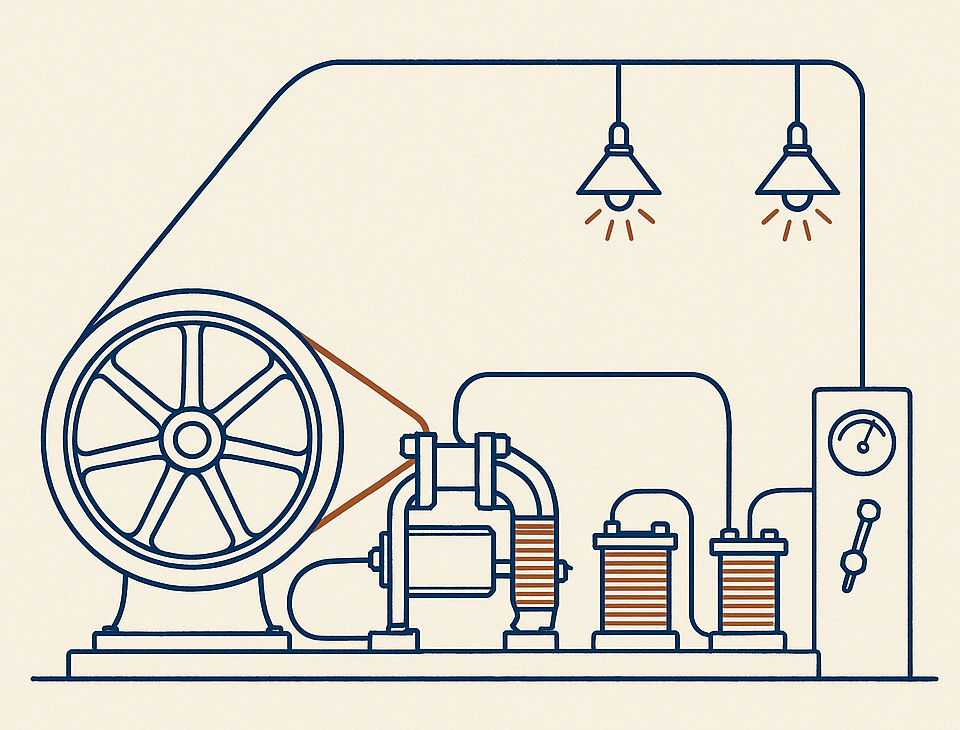
Picture an iron ring with four coils wound on it: one at the top, one at the bottom, one on each side. The top and bottom coils are wired together as one circuit. The left and right coils are wired together as a second circuit, entirely separate — there is no connection between the two anywhere in the machine. Now feed them alternating currents of the same frequency, and arrange for the second to reach its peak a quarter of a cycle after the first.
At the instant when the first circuit is at maximum and the second is passing through zero, the ring's magnetic pole sits at the top. A quarter of a cycle later the first has fallen to zero and the second is at maximum, and the pole has moved a quarter of the way round, to the side. A quarter of a cycle after that the first circuit is at maximum in the opposite direction, and the pole is at the bottom. It is not switched from station to station: at every intermediate instant both circuits are carrying something, and the pole sits wherever the two pulls add. It slides. In one cycle of the supply it makes one complete circuit of the ring. The patent's own phrase for this is “a progressive shifting of the magnetism or of the lines of force”.1
Now drop a copper cylinder into the middle of the ring, on a pivot, with no electrical connection to anything at all. The moving field induces currents in the copper; those currents produce a field of their own; the two fields pull on one another and the cylinder is dragged around after the pole. It never catches up. If it did, the field and the copper would be travelling together, nothing would be changing from the copper's point of view, no current would be induced in it, and there would be nothing left to pull it along. The lag is not a defect to be engineered out. It is the mechanism.
What is missing from that description is the part every electric motor before it depended on. A direct-current motor has to reverse the current in its own rotating windings twice per revolution, and it does this mechanically, with a commutator: a split ring of copper segments with brushes pressed against it, making and breaking a live circuit thousands of times a minute. Commutators spark. They wear. They shed carbon dust and they need a man with a spanner. They are also a poor thing to install in a flour mill, a textile shed or a coal mine, which are exactly the places that wanted power. The rotating-field motor has no commutator, no brushes and no electrical connection to its moving part whatever. There is nothing in it to spark and nothing to wear but the bearings.
Now the record.
Alternating current was not waiting to be invented in 1887. It was what came out of the first generator anybody built. Michael Faraday demonstrated induction in 1831; the following year the Parisian instrument maker Hippolyte Pixii built a machine that spun a horseshoe magnet past a pair of coils, and the current that came out of it reversed direction twice per revolution, because that is what induction does. Direct current was the retrofit. On a suggestion from André-Marie Ampère, Pixii added a rocking switch that flipped the connections in step with the magnet, so that the output always ran one way. Alternating current is the older of the two by the width of a modification, and it is twenty-four years older than the man in the headline.
It was also being sold. Pavel Yablochkov's arc “candle”, patented in Paris in March 1876, used alternating current for a specific engineering reason: on direct current one of its two carbon rods burned away roughly twice as fast as the other, and reversing the current every half cycle wore them down evenly. By 1878 candles of this kind were lighting the avenue de l'Opéra, the most conspicuous electric installation in the world at the time, and they were running on alternating current nine years before Tesla filed.
Transformers likewise. Lucien Gaulard and John Dixon Gibbs patented a “secondary generator” in Britain in 1882, and at the 1884 International Electrical Exhibition in Turin they used it to feed lamps some forty kilometres down the railway line from Lanzo. The following year at the Ganz works in Budapest, Károly Zipernowsky, Miksa Déri and Ottó Bláthy patented the closed-iron-core design with the loads connected in parallel instead of in series — the arrangement every distribution network on earth still uses — and gave the device the name transformer.
And in America the thing was already lit. George Westinghouse bought the American Gaulard–Gibbs rights in 1885 and set William Stanley to redesigning the apparatus. In March 1886 Stanley lit offices and shops along Main Street in Great Barrington, Massachusetts, from a single generator through step-up and step-down transformers. The IEEE plaque in the town, dedicated in October 2004, gives the date as 20 March 1886; several accounts give 6 March, the day the system was first run, with the public demonstration a fortnight later. The disagreement is about which day deserves the plaque, not about the year, and the year is the point. It is eighteen months before anything was filed in Washington.
So by 12 October 1887, alternating current was being generated, transformed, distributed and billed for on two continents. “He invented alternating current” takes a distribution system assembled by a dozen people over half a century and collapses it into the shape of a waveform. The claim is not so much false as category-confused, and the confusion costs him the credit for what he actually did.
What was actually missing was a motor.
Alternating current lit lamps, and it could not turn a shaft. A filament and a carbon arc do not care which way the current runs; a machine tool does. The motors that existed were commutator machines, and putting alternating current into a commutator machine sets the commutator — whose entire job is to reverse the current at the right instant — to fighting a supply that is already reversing on its own account. The result was an industry that ran alternating at night, for light, and direct by day, for work, with a separate plant for each. Whoever produced a motor that ran properly on alternating current would decide which of the two systems the twentieth century was going to be wired for.
Attempts were being made. Elihu Thomson had published, in Electrical World of 28 May 1887, the effect his own alternating-current motors were built on: a copper ring in an alternating field twists until it stands edgeways to the lines of force. Others were circulating too — Tesla's own paper of May 1888 lists four alternating-current motors already spoken of, Thomson's among them. What none of them had was a field that went round.
Tesla filed on 12 October 1887, and filed for a system rather than a machine: one broad application claiming both a motor and a method of transmitting power to it. Three more followed before the end of the year, two on 30 November and one on 23 December. The examiners refused to let a single document claim both the motor and the system of transmission, so on 9 March 1888 three of the four applications were divided in two, and the seven resulting patents were issued together on 1 May 1888 — 381,968, 381,969 and 382,279 for the motors, 381,970 for a system of electrical distribution, and 382,280, 382,281 and 382,282 for transmitting and converting power. US 382,280 says as much on its own face: “This application is a division of an application filed by me October 12, 1887, No. 252,132.”2
Two weeks after the grant, on 16 May 1888, he read a paper to the American Institute of Electrical Engineers in New York. Its title was A New System of Alternate Current Motors and Transformers. It announces a new system of motors and transformers for use with alternating currents. It does not announce alternating current.3
The most exact statement of what the patents covered was written twelve years later by somebody with every reason to be careful about it. In 1900, in Westinghouse Electric & Mfg. Co. v. New England Granite Co., Judge Townsend of the circuit court in Connecticut sustained three of the 1 May 1888 patents against the argument that earlier workers had got there first, and defined the invention as
the production of a continuously rotating or whirling field of magnetic forces for power purposes by generating two or more displaced or differing phases of the alternating current, transmitting such phases, with their independence preserved, to the motor, and utilizing the displaced phases as such in the motor.
Westinghouse Electric & Mfg. Co. v. New England Granite Co., 103 F. 951, 964 (C.C.D. Conn. 1900); the same sentence is quoted back in the affirmance, 110 F. 753, 756 (2d Cir. 1901).
Not one word of that is a claim to alternating current. The invention is the phases: producing more than one of them, keeping them independent on separate wires the whole way from generator to motor, and using the difference between them as the thing that does the work. It is a narrower claim than the popular one and a much harder one to have thought of.
Turin, three years earlier.
Galileo Ferraris was professor of technical physics at the Royal Industrial Museum in Turin, and in 1884 he organised the electrical section of the exhibition where Gaulard and Gibbs showed their secondary generator. He came at the problem from optics. Two light waves ninety degrees out of step produce circular polarisation, and Ferraris reasoned that if the primary and secondary currents of a transformer stood in a similar relation, two coils fed from them ought to produce a circular effect of the same kind.
In the autumn of 1885 he built the test. Two flat coils set at right angles, a small hollow copper cylinder hung in the space between them, the coils fed from the primary and the secondary of a Gaulard–Gibbs transformer, which are naturally out of step with each other. With one coil live, the cylinder hung still. Switch on the second and it turned. Ferraris had a rotating magnetic field in a laboratory in Turin, two years before anything was filed in Washington, and he had arrived at it for a reason nobody else had: he was trying to measure a phase difference, not to build a motor.
He did not publish for three years, and read his paper — Rotazioni elettrodinamiche prodotte per mezzo di correnti alternate — to the Reale Accademia delle Scienze di Torino on 18 March 1888. Part of it was printed at Milan in the journal L'Elettricità on 22 April 1888, and the whole was reprinted after his death in his collected works. That printed date later carried enormous weight in American courtrooms — not against the seven patents, which were already filed, but as the prior art thrown at a later pair of Tesla's, on splitting a single current into two phases.4
And he drew the opposite conclusion. His theory of the machine was that the pull on the cylinder is proportional to the slip — to the margin by which the field outruns it — so the closer the rotor creeps to the speed of the field, the less work it can do. A motor made this way, he remarked, “could not have any importance as a means of industrial transformation of power”.5 He built a larger one anyway, with a ten-pound copper cylinder on a horizontal shaft. It too was of very little power.
That is why the two men are not rivals of the sort the story requires. Ferraris took out no Italian patent on the rotating field. He published it, and published it with a verdict attached telling the reader not to expect much of it. The first notices in English — Industries on 18 May 1888 and The Electrician a week later — left that verdict out, so English-speaking engineers met the discovery with its discouraging half removed. Tesla testified under oath in a patent case that those notices were how he first learned of Ferraris at all, in 1888, seven months after his own filing.6
Nothing was taken in either direction. One man demonstrated the effect first and published it second, with the wrong verdict attached; the other reached it separately and filed first, with the right one. And there was a third: Oliver B. Shallenberger, an engineer at Westinghouse, ran into the same effect independently in the spring of 1888 when a small spring dropped into the field of an alternating-current meter he was building and began to spin. Three people found the same thing inside three years without borrowing it from each other. That is what a ripe idea looks like, and it is a better story than a lone genius: it has more people in it and none of them is a villain.
Westinghouse, who had to buy rather than admire, hedged. He sent his associate Guido Pantaleoni to Turin to secure the American rights to Ferraris's ideas for $1,000, and on 7 July 1888 bought the Tesla patents outright.7 The market did not divide the credit. It bought both claims and built on one.
In Europe the credit still runs the other way, and not unreasonably. The IEEE milestone plaque at the Turin Polytechnic, dedicated on 21 January 2021, records that Ferraris “conceived and demonstrated the principle of the rotating magnetic field”. Both sentences are true at once, and a publication that has to choose one of them has stopped reading.
What the motor did to the system.
The patents did not slot neatly into the network that existed. Westinghouse's lighting circuits ran at 133 cycles per second, a frequency chosen high so that customers would not see their lamps flicker. Induction motors prefer a much lower one; in Pittsburgh in 1888 Tesla set his own polyphase machines up to run at 50.8 A lamp and a motor wanted different supplies, and the American standard eventually settled near the motor's end of the argument, at 60 cycles, where it has stayed. The interesting historical claim is not that he invented alternating current but that the arrival of a workable alternating-current motor forced the system carrying it to be rebuilt around the motor.
The design that actually went into the world's factories arrived a little later and from somewhere else again. Mikhail Dolivo-Dobrovolsky, working at AEG in Germany, developed three-phase working and the short-circuited “squirrel-cage” rotor at the end of the 1880s, and in 1891 three-phase power was carried about 175 kilometres from Lauffen to Frankfurt for the International Electrotechnical Exhibition, arriving with roughly three-quarters of the energy that set out. The induction motor bolted to a modern compressor is a three-phase cage machine, and its ancestry runs through Frankfurt at least as directly as through the four-coil ring of 1888. Saying so takes nothing away from the patents. It only puts the right number of people in the room.
The commercial proof came at Niagara. The Cataract Construction Company settled on two-phase alternating current for local distribution in 1893 and built a powerhouse that eventually held ten Westinghouse generators of 5,000 horsepower apiece; it began transmitting to Buffalo in November 1896, and utilities on both sides of the Atlantic moved to polyphase behind it.9 The newspapers of the day put Tesla in that powerhouse, and a good deal of what has been written since has left him there. He was not in it. He did not design the Niagara installation, and the engineers who did were employed by the company that had bought his patents. What he had supplied was the arrangement the whole plant was built around, which is a different sort of contribution and, on the evidence, the decisive one.

The part of the story with only one source.
The best-known moment in the whole account is the one that cannot be checked. In February 1882, walking in a park in Budapest at sunset with a friend and reciting Goethe, Tesla is said to have seen the answer whole and drawn the arrangement in the sand with a stick. The account appears in My Inventions, the autobiographical series he published in 1919, thirty-seven years after the event it describes. In sworn testimony in a patent case in 1903 — where establishing 1882 as the date of invention would have been worth a great deal to him — he did not tell it.10 That is not a reason to call the story false. It is a reason to label it. Source is Tesla alone
So what is the accurate sentence?
He did not invent alternating current, the alternator, the transformer or alternating-current lighting. Every one of those was in commercial service, and in some cases had been for decades, before he filed. What he invented — independently, and first to the patent office — was a way of making alternating current turn a shaft with no commutator anywhere in the machine, together with a system of generation and transmission designed around it. A judge spent one careful sentence on it in 1900 and got it exactly right. It is a smaller claim than the one on the poster. It is also the one that can be verified in an afternoon, and it is the reason that whatever is humming on the other side of your wall is running at all.
The document
US 381,968 — Electro-Magnetic Motor. Filed 12 October 1887, granted 1 May 1888.
US 382,280 — Electrical Transmission of Power. A division of the same 12 October 1887 application, divisional papers filed 9 March 1888, granted 1 May 1888.
Titles and dates transcribed from the patent faces. Both patents are out of copyright and both are linked above to the scanned grant. They appear in context in the list of United States grants.
Search log
EARLIEST TRACE of the sentence “Tesla invented alternating current”: not located. Full-text searching of the Internet Archive and HathiTrust for the phrase returned no datable first appearance, and neither service would answer a phrase query cleanly enough to rest a date on. The claim is reported here as unsourced rather than assigned an origin it may not have.
William Stanley's own account of 1886 was read to the American Institute of Electrical Engineers on 15 February 1912 and printed in the Journal of the Franklin Institute, volume 173. A printing in Electrical World, which is sometimes cited, was not located; the page range for the Franklin Institute printing is given differently by different catalogues and is therefore omitted above.
The Great Barrington date is given as 20 March 1886 on the IEEE plaque and as 6 March in several local and technical accounts. Both are reported here rather than resolved.
A United States application in Ferraris's name was pursued after Westinghouse bought the American rights, and it ran into Tesla's. Two federal opinions record Patent Office interference proceedings between the two men, in which Tesla's priority was sustained: Westinghouse Electric & Mfg. Co. v. Roberts, 125 F. 6 (C.C.E.D. Pa. 1903), which refused to let the interference record be used against a stranger to it, and Westinghouse Electric & Mfg. Co. v. Mutual Life Ins. Co., 129 F. 213 (C.C.W.D.N.Y. 1904), where the experimental motor Tesla had filed as an exhibit in that interference reappears as evidence — it survived the 1895 laboratory fire only because it was sitting in Washington. The interference file itself was not consulted for this article.
Ferraris's verdict on his own motor is quoted above in Silvanus Thompson's 1895 English wording. Translations of the Turin paper differ between accounts, and this one was preferred because a reader can open it and check it.
Sources
Primary documents
- Electro-Magnetic Motor, US Patent 381,968, filed 12 October 1887, granted 1 May 1888.
- Electrical Transmission of Power, US Patent 382,280, granted 1 May 1888.
- Westinghouse Electric & Mfg. Co. v. New England Granite Co., 103 F. 951 (C.C.D. Conn., 29 August 1900), sustaining Nos. 381,968, 382,279 and 382,280; affirmed 110 F. 753 (2d Cir., 22 August 1901).
- “A New System of Alternate Current Motors and Transformers”, Transactions of the American Institute of Electrical Engineers 5, no. 10 (July 1888), 308–27; reprinted in T. C. Martin, The Inventions, Researches and Writings of Nikola Tesla (New York, 1894), 9–25.
- Elihu Thomson, “Novel Phenomena of Alternating Currents”, Electrical World (New York) 9 (28 May 1887), 258.
- Galileo Ferraris, Rotazioni elettrodinamiche prodotte per mezzo di correnti alternate, read to the Reale Accademia delle Scienze di Torino, 18 March 1888; reprinted in Opere di Galileo Ferraris, vol. I (Milan: Hoepli, 1902), 333–48.
- Notices of the Ferraris paper in English: Industries, 18 May 1888, 505–6, and The Electrician, 25 May 1888.
Further reading
- Silvanus P. Thompson, Polyphase Electric Currents and Alternate-Current Motors (London: E. & F. N. Spon, 1895), 88–90 on Ferraris, 106–10 on the Lauffen–Frankfurt transmission, 172 on Elihu Thomson's motor. Written seven years after the events, by a man who knew the participants.
- W. Bernard Carlson, Tesla: Inventor of the Electrical Age (Princeton University Press, 2013), chapter 5, especially 108–11 on Ferraris and Shallenberger.
- IEEE Milestone, “Rotating Fields and Early Induction Motors, 1885–1888”, dedicated at the Turin Polytechnic, 21 January 2021.
- IEEE Milestone, “Alternating Current Electrification, 1886”, Great Barrington, Massachusetts, dedicated 2 October 2004.
- M. Mitolo and M. Tartaglia, “Galileo Ferraris: A Life Dedicated to the Electrical Sciences”, IEEE Industry Applications Magazine, September–October 2016, 8–11.
- “Jablochkoff Candles in Paris”, Engineering and Technology History Wiki, on the 1878 installations.
- William Stanley, “Alternating-Current Development in America”, read to the AIEE 15 February 1912, Journal of the Franklin Institute 173 (1912).
Notes
- US 381,968, specification: two or more independent circuits “through which alternate currents are passed at proper intervals … for the purpose of effecting a progressive shifting of the magnetism or of the lines of force”. ↩
- US 382,280, first line of the specification. The parent application, Serial No. 252,132, was filed 12 October 1887; the divisional papers were filed 9 March 1888 as Serial No. 216,755. ↩
- Transactions of the American Institute of Electrical Engineers 5, no. 10 (July 1888), 308–27; the volume runs from October 1887 to September 1888. The discussion that followed the paper is printed with it, and the record ends at 327. ↩
- The Milan printing of 22 April 1888, in L'Elettricità, is fixed as a date by the courts that weighed it as prior art against Tesla's later split-phase patents, Nos. 511,559 and 511,560: Westinghouse Electric & Mfg. Co. v. Catskill Illuminating & Power Co., 121 F. 831 (2d Cir. 1903), which held them anticipated by it; Westinghouse Electric & Mfg. Co. v. Roberts, 125 F. 6 (C.C.E.D. Pa. 1903); and Westinghouse Electric & Mfg. Co. v. Mutual Life Ins. Co., 129 F. 213 (C.C.W.D.N.Y. 1904), both of which carried the invention back behind it on fuller evidence. ↩
- Silvanus P. Thompson, Polyphase Electric Currents and Alternate-Current Motors (London: E. & F. N. Spon, 1895), 88–90, reporting the Turin paper in English within seven years of it: the 1885 experiments, the remark quoted here, the slip theory, and the larger model with its ten-pound copper cylinder. ↩
- Carlson, Tesla, chapter 5 note 26, citing the Industries and Electrician notices and Tesla's motor-patent testimony at 170. ↩
- Carlson, Tesla, 111 (Pantaleoni, $1,000) and 113–14 (the agreement of 7 July 1888: cash, notes and a royalty of $2.50 per horsepower). ↩
- Carlson, Tesla, 114–15, on the 133-cycle lighting circuits and the 50-cycle polyphase machines. ↩
- Carlson, Tesla, 169–73, on the Cataract Construction Company's choice of two-phase current, the ten 5,000-horsepower generators, and the transmission to Buffalo in November 1896. ↩
- Carlson, Tesla, 52–55, comparing the account in My Inventions (1919) with the patent testimony of 1903. ↩
Read next
-
1885–1893 · The polyphase patents
The war of the currents was an argument about copper
Edison was not fighting Tesla. He was fighting a rival company, over the price of transmission and how far a central station could reach.
-
What a Tesla coil actually does
Two tuned circuits, energy passing between them, and a voltage that climbs because the circuits agree on a frequency. It was never a way to distribute power.
The record on this claim
- False “Tesla invented alternating current.” Generation, transformers and alternating-current lighting were all in commercial service before the applications of 12 October 1887. What the seven patents of 1 May 1888 claim is a rotating field produced from displaced phases, and a motor with no commutator in it.
- Independent discovery “Tesla stole the rotating field from Ferraris.” — or the reverse. Ferraris demonstrated the effect in Turin in 1885 and published on 18 March 1888, having concluded it had no industrial future. Tesla filed on 12 October 1887 and testified that he first read of Ferraris in the English notices of May 1888.
- Source is Tesla alone “He saw the whole idea in a Budapest park in 1882.” The account is his own, published in 1919. He did not give it in sworn testimony in 1903, when an 1882 date would have helped him.