1885–1893 · The polyphase patents
The war of the currents was an argument about copper
Edison was not fighting Tesla. He was fighting a rival company, over the price of transmission and how far a central station could reach.
On 4 September 1882 a switch was closed at 255–257 Pearl Street in lower Manhattan and six steam-driven dynamos began pushing direct current into a network of buried conductors. About four hundred lamps came on, in the offices of eighty-two customers, inside a district bounded by Spruce Street, the East River, Wall Street and Nassau Street.1 The generating plant was rated at six hundred kilowatts and the mains ran at 110 volts. Within two years the same station was carrying more than ten thousand lamps.
Pearl Street is remembered as the first central station. The word that matters in it is central. Before 1882 an electric light was a thing you owned along with the engine that ran it: a hotel or a mill bought a dynamo, a boiler and a man to tend them. What Edison sold at Pearl Street was the separation of the two — the customer bought light by the lamp-hour, and somebody else owned the machinery. That is a business model before it is a technology, and one physical parameter decides whether it works: how far the wire can go before the wire costs more than the customers at the end of it are worth.
Everything that followed — the pamphlets, the dogs at Columbia College, the chair at Auburn Prison, the elephant — hangs off that parameter. The fight that American schoolrooms still teach as a duel between two inventors was, in its engineering, an argument about the price of a metal.
The arithmetic of the mile.
A direct-current station in 1882 generated at roughly the voltage the lamps ran at, because nothing existed to change the voltage in between. That constraint sets the whole problem. The power delivered is the current multiplied by the voltage, so a low voltage means a large current; and the heat wasted in the line goes as the square of the current. The only way to hold the waste down is to make the conductor fatter.
Work it through for a plausible load and the numbers stop being abstract.
What a mile of 110-volt feeder cost in metal
ASSUMPTIONS
Load — 55 kW at 110 V: about 660 lamps, at the 83 watts each that a 100 kW Jumbo dynamo rated for 1,200 lamps implies
Distance — one mile, 1,609 m, station to load
Line loss — 10 per cent of the delivered power
Conductor — copper, resistivity 1.72 × 10⁻⁸ Ω·m, density 8,960 kg/m³
WORKING
Current: 55,000 ÷ 110 = 500 A
Permitted line resistance: 5,500 ÷ 500² = 0.022 Ω
Cross-section: (1.72 × 10⁻⁸ × 3,218 m) ÷ 0.022 = 2,516 mm² per conductor
— a square copper bar 50 mm on a side, in each of the two conductors
Mass of copper: 2,516 mm² × 3,218 m × 8,960 kg/m³ = 72,500 kg
AT 2,200 VOLTS
Copper falls with the square of the voltage: (2,200 ÷ 110)² = 400
Cross-section: 6.3 mm² per conductor. Total copper: 181 kg.
The distance term is worse than it looks. Hold the load and the permitted loss fixed and the copper rises with the square of the distance: two miles needs four times the metal of one.
Seventy-two tonnes of copper, to light six hundred-odd lamps a mile away. At the London price copper reached in December 1887 — £80 a ton — that is about £5,700 of metal buried in the street before a single lamp is sold.2 Push the same station out to two miles and the bill is four times larger. This is the origin of the figure that appears in every account of the period without explanation: the economic radius of a low-voltage direct-current station was about a mile. It was not a rule of thumb. It was the point at which the trench stopped paying.
The consequence for the business is severe. A central station can only sell to people standing more or less on top of it, which means it can only exist where the customers are dense — city blocks, hotels, banks. A town of five thousand people spread over four miles is not a market. Neither is a factory outside the city. Neither, emphatically, is a waterfall twenty miles from anywhere.
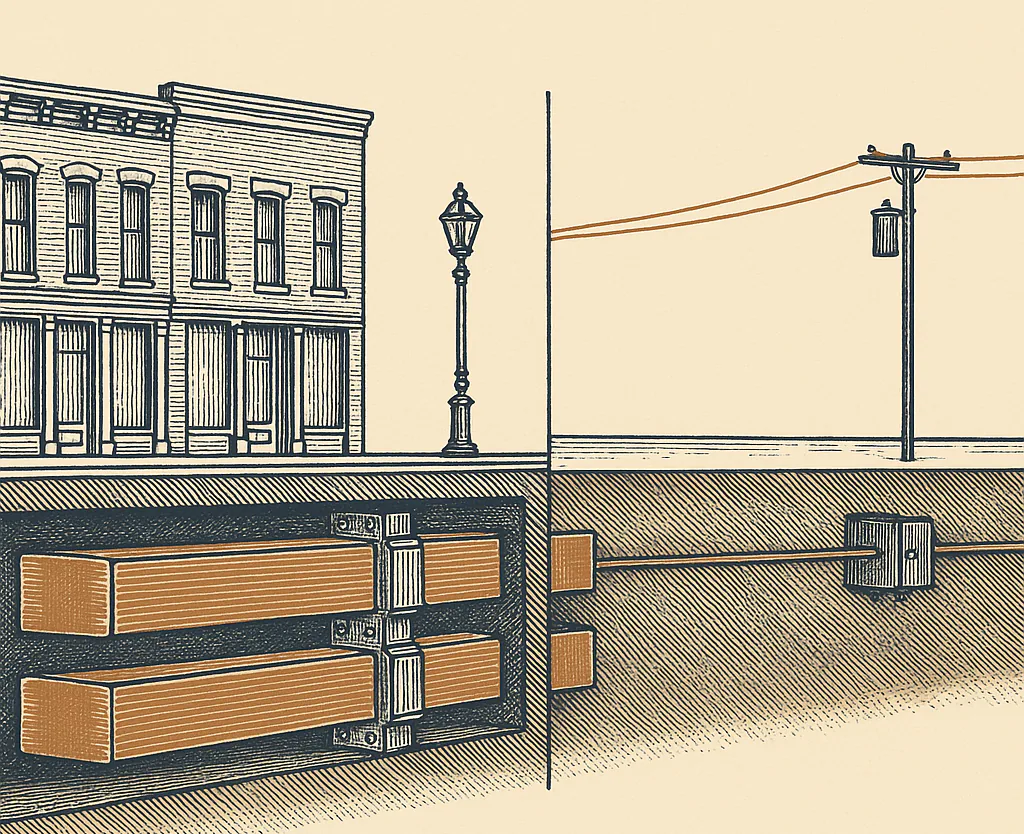
Two wires · 110 V
Three wires · 110 + 110 V
Alternating · 2,200 V
Hatched: one conductor in section, every distance drawn to the same scale. Dashed: the same conductor for 22 miles, Niagara Falls to Buffalo. Sterling at £80 a ton.
Edison's own answer, and why it was not enough.
Edison understood the arithmetic better than anyone, and he attacked it directly. His three-wire system, filed on 27 November 1882 and granted as US 274,290 on 20 March 1883, ran two circuits back to back around a shared neutral so that the mains carried the difference rather than the sum.3 The specification puts the motive plainly: raise the electromotive force and “the size of the conductors which convey said current may be diminished, thus economizing in metal.” His feeder-and-main layout attacked the same term from another direction, and the first three-wire central station opened at Sunbury, Pennsylvania, in 1883.
These were real engineering gains and they mattered commercially. They were also, in the language of the arithmetic above, a constant factor. Three-wire distribution cut the copper by a useful fraction. It did not change the fact that the copper scales as the inverse square of the voltage, and it could not change the voltage, because the lamps and the mains were locked to each other. To break that lock you need a device that trades voltage for current without a rotating machine in between. That device is the transformer, and it does not work on direct current.
The transformer arrives, with a company attached to it.
Lucien Gaulard and John Dixon Gibbs had been showing an alternating-current “secondary generator” in Europe since the early 1880s. In the summer of 1885 George Westinghouse — until then an air-brake and gas manufacturer with a habit of buying promising patents — sent an engineer, Guido Pantaleoni, to look at the system, then bought the American rights and shipped a batch of the transformers and a Siemens alternator to Pittsburgh.4
The Gaulard–Gibbs arrangement as sold was wired in series and was not much use for lighting a street. William Stanley Jr., working for Westinghouse, rebuilt it in parallel and demonstrated the result at Great Barrington, Massachusetts, on 20 March 1886: a 500-volt Siemens generator stepped up to 3,000 volts, run along Main Street on the elm trees, and stepped down again in shop basements to the 100 volts the lamps wanted.5 On 30 November 1886 the first commercial alternating-current central station in the United States went into service in Buffalo, a 400-lamp Westinghouse system with a 1,000-volt primary.6 A year later Westinghouse had sixty-eight central stations running or under contract against Edison's hundred and twenty-one, having been in the business a fraction of the time.
That is the event the war of the currents is actually about. A transformer does not generate anything and it wastes very little; what it does is uncouple the voltage on the long wire from the voltage at the lamp. Once that coupling is broken, the inverse-square term in the copper calculation becomes a lever a company can pull. A station could sit outside the district it served, sell to a town instead of a block, and — later — sit at a waterfall.
Fig. 2 needs one qualification. An alternating-current system does not escape thick copper; it relocates it. The high-voltage primary that runs the miles is thin, but the low-voltage secondary between a transformer and the lamps it feeds is as fat as any Edison main — it is simply a few hundred feet long instead of a mile, so the square of the distance is working for you rather than against you. Add the transformers themselves, their idling losses and, in the early years, the absence of a workable motor and a workable meter, and the alternating system was not free. It was cheaper per mile by a margin that grew with every mile, which for a company trying to sell current to a town rather than a block is the only margin that matters.
Two things follow immediately, and both are commercial rather than scientific. Edison's patents, his cable plant, his network of licensed local companies and his installed base were all built around the mile. And a competitor had arrived with a technology that made the mile irrelevant, at exactly the moment Edison's system was at its most capital-intensive.
Where Tesla enters, and in what capacity.
The one genuine technical deficiency in the alternating-current case was the motor. Direct current ran motors well; early alternating-current systems ran lamps and little else, which mattered because daytime motor load is what makes a generating station pay between dusks.
On 12 October 1887 Tesla filed the application that issued on 1 May 1888 as US 381,968, and a division of it that issued the same day as US 382,280, describing a motor with no commutator in which two circuits carrying currents a quarter-cycle apart walk a magnetic pole around a ring and drag a rotor after it. He read the scheme to the American Institute of Electrical Engineers at Columbia College on 16 May 1888. In July of that year Westinghouse Electric licensed the polyphase patents, the substance of the deal being a royalty measured in horsepower, and Tesla spent roughly a year as a consultant in Pittsburgh.7
Note the shape of that. Tesla licensed a patent portfolio to one of the two companies in the fight and then went back to his own laboratory. He was not an officer of Westinghouse Electric, he had no equity position that made him a principal, and he did not campaign in the press. His name is essentially absent from the documentary record of the propaganda war that followed — from the pamphlets, from the demonstrations, from the legislative lobbying, from the litigation. The record instead shows two corporations and their agents. Tesla was a licensor. He was not a combatant, and the popular framing that puts him opposite Edison in a personal duel has to delete an entire company, and its founder, to make room for him.
The copper corner.
In October 1887 Pierre-Eugène Secrétan, who ran Europe's largest copper fabricator on credit from a syndicate of French banks, set out to corner the world copper market. He signed three-year contracts for the output of thirty-seven producers at a fixed price and bought heavily on the London Metal Exchange, and he made no effort to hide it. Copper went from £39 a ton at the start of October to £80 by December, and stayed near there until the syndicate collapsed in March 1889, taking its principal bank with it.8
So in the precise months when the two American electrical systems were fighting over how much conductor each of them needed, the price of conductor roughly doubled. Copper was not a background cost in 1888. It was the most volatile line in the estimate, and everybody in the industry knew it.
Brown's letter, and what it concedes.
On 5 June 1888 the New York Evening Post printed a letter from a consulting electrician named Harold P. Brown. It called the overhead alternating-current lines a public menace, and it explained why they existed:
The only excuse for the use of the fatal alternating current is that it saves the company operating it from spending a larger sum of money for the heavier copper wires which are required by the safe incandescent systems.
Harold P. Brown, letter, New York Evening Post, 5 June 1888.9
Read it twice. The sentence is written as an accusation and it is in fact a concession: the man leading the safety campaign states, in his opening move, that the rival system's advantage is conductor cost. Nothing in the entire controversy states the engineering more honestly than its chief opponent's first letter.
What Brown did next is documented in detail. On 30 July 1888, in a lecture room at Columbia College, he killed a dog with alternating current in front of an audience of electricians and officials, having first shown that a higher direct-current voltage did not kill it. On 5 December 1888, at Edison's laboratory at West Orange, he killed two calves and a horse with 700 to 770 volts of alternating current in front of reporters, the Medico-Legal Society's committee on electrical execution, and Elbridge Gerry, who had chaired the state's death-penalty commission and drafted the execution law.10 The Edison Electric Light Company had already published, early in 1888, an eighty-three page pamphlet titled A Warning from the Edison Electric Light Company, which reprinted accounts of deaths by high-voltage current and named the backers of the alternating system.11 Edison himself argued the case in public over his own signature in the North American Review for November 1889, and Westinghouse answered him in the same magazine the following month.12 For a season the newspapers tried out “westinghoused” as a verb.
The campaign was not fighting a phantom. On 11 October 1889 a Western Union lineman, John Feeks, was killed on a pole at Centre and Chambers Streets in Manhattan in front of a lunchtime crowd, burning in the tangle of wires for half an hour before he could be brought down. The overhead wire panic that followed was a rational response to a genuinely lethal streetscape, and it is the reason New York's wires went underground.
Nor was Edison's own position simply a pose. He had built a system he believed was safe by construction, at a voltage that would not kill, buried where nobody could touch it, and he watched a competitor string ten times that voltage over the heads of pedestrians in a city with no wiring code worth the name. The Edison Papers project, which has read more of his correspondence than anyone, characterises the motives as mixed, with some of them plainly self-serving — which is the honest verdict, and a more useful one than either of the two available cartoons. A man can hold a sincere safety conviction and also notice that acting on it would ruin his rival.
The campaign was also not what it claimed to be. In August 1889 the New York Sun printed forty-five letters stolen from Brown's desk showing that the independent expert had been taking direction and money from the Edison interests and from Thomson-Houston, the other large direct-current maker.13
Auburn Prison, 6 August 1890.
New York had been looking for a replacement for hanging since a state commission was appointed in 1886. The Electrical Execution Act was signed in June 1888 and took effect on the first day of 1889. Edison had already written to Alfred P. Southwick, the Buffalo dentist who was the commission's most persistent advocate of electricity, on 19 December 1887; the letter is in the Edison Papers.14
The statute said the state would kill by electricity. It did not say with whose machine. Brown solved that problem by acquiring three second-hand Westinghouse alternators through intermediaries — Westinghouse would not knowingly have sold them — and supplying them to the three state prisons.15
The first man sentenced under the act was William Kemmler, a Buffalo produce peddler who killed Matilda Ziegler with a hatchet on 29 March 1889 and was convicted on 10 May. His appeal — that death by electricity was cruel and unusual punishment — was argued by W. Bourke Cockran, one of the country's best-paid orators, for a client who could not have paid him; nobody has produced the cheque, but the assumption then and since is that the money was Westinghouse's. The appeal failed in the state courts, and on 23 May 1890, three days after argument, the Supreme Court of the United States declined to disturb the result in In re Kemmler, 136 U.S. 436, holding that the choice of method was for the legislature.16
Kemmler was executed at Auburn Prison on the morning of 6 August 1890. The first application, about a thousand volts for seventeen seconds, did not kill him; witnesses saw him still breathing. A second, longer application did, and left the room full of smoke and the smell of burnt flesh. The whole business took something like eight minutes and was reported at length and in horror.
It is worth being exact about what this episode was and was not. It was a commercial manoeuvre: a manufacturer's competitor arranged for the state to kill people with the competitor's machine, so that the machine and the killing would be joined in the public mind. It was also a failure at the level it was aimed at. Two months later the Westinghouse system went on selling, and within a few years it had taken the two contracts that settled the industry.
The fifty thousand dollars.
The other thing everyone knows about this period is that Edison cheated Tesla out of a bonus. Here is what the record actually contains.
Source is Tesla alone
Tesla arrived in New York in 1884 and worked for the Edison Machine Works for something under a year, on dynamos, before leaving. Thirty-four years later, in the fourth instalment of the autobiographical series he wrote for The Electrical Experimenter in 1919, he described redesigning twenty-four machines and then this:
The Manager had promised me fifty thousand dollars on the completion of this task but it turned out to be a practical joke. This gave me a painful shock and I resigned my position.
Nikola Tesla, “My Inventions IV: The Discovery of the Tesla Coil and Transformer,” The Electrical Experimenter 7, no. 1 (May 1919), p. 65.17
Three observations, all of which the popular version loses. The promise is attributed to “the Manager,” not to Edison. The only source for the episode is Tesla's own account, published thirty-four years after the events; no contract, letter or ledger entry corroborating a fifty-thousand-dollar offer has been located. And the famous punchline — “Tesla, you don't understand our American humor” — is not in that text. It appears in a 1944 biography written after Tesla's death, and it is quoted today as though it were transcribed at the time.18
None of that makes the story false. Tesla was not a liar, and being underpaid by an employer is not an extraordinary claim. It does mean the anecdote is testimony, not documentation, and it belongs in a different column from the patent dates and the court reports. It also happened in 1884–85, before Great Barrington, before Brown, before the Westinghouse licence — which is to say before there was a war of the currents to be a grievance in.
The elephant, which belongs to a different decade.
Topsy was an Asian elephant sold off by the Forepaugh and Sells Brothers' circus in 1902 and put to work on Coney Island hauling timber for the building of Luna Park. She was killed there on 4 January 1903 by three methods at once: carrots dosed with potassium cyanide, about 6,600 volts for some ten seconds, and a steam winch that then drew two nooses tight round her neck for ten minutes. The park's owners, Frederic Thompson and Elmer Dundy, made the decision after her drunken handler was dismissed and she got loose in the streets; the American Society for the Prevention of Cruelty to Animals had already blocked their plan to hang her in public and sell tickets at a quarter a head. A camera crew from the Edison Manufacturing Company filmed it, and the film was released on 17 January 1903 as Electrocuting an Elephant and deposited at the Library of Congress as a paper print, which is why it survives when almost nothing else about the day does.
The claim that Edison electrocuted an elephant to discredit alternating current fails on every element.
- The date. January 1903 is thirteen years after Kemmler and more than a decade after the fight ended. Edison General Electric had merged with Thomson-Houston in April 1892 to form General Electric, and Edison had left the lighting business with it. There was no tariff war left to fight and no company of his to fight it for.
- The decision. It was made by the park, over a dangerous animal, in a period when the public killing of elephants was not unusual. The Edison Papers project at Rutgers has examined the question and answers it in one word: was Edison to blame, did he have anything to do with it — “the answer is an emphatic no.”19
- The presence. Edison is not mentioned in any of the contemporary newspaper accounts, and nothing in his surviving correspondence refers to Topsy at all. The confusion is partly a matter of names. The current was supplied by the Edison Electric Illuminating Company of Brooklyn — a local utility that carried the name under licence and that he did not direct — and the film carried it because his manufacturing company owned the camera.
Even the animal's own story is usually told wrong in the other direction. The press of January 1903 described a killer of three men in three years. Later research through the circus and newspaper record could verify one death — that of J. F. Blount, who got drunk and into her pen in Brooklyn in May 1902 and burned her trunk with a cigar — and could not confirm the others.20 A story that circulates as an indictment of Edison turns out to be an indictment of an amusement park, and the number in it is not right either.
What the Edison company genuinely did was point a camera at it. That is the whole of the connection, and it is also the reason the myth exists: the film is the only vivid artefact from the entire war-of-the-currents period, so it has been recruited to illustrate a fight it has nothing to do with. Popular retellings from the mid-2000s onward attached it firmly to Edison, and it has been repeated in magazines and on television since.
How it actually ended.
Not with a verdict. With a merger and two contracts.
The combination of Edison General Electric with Thomson-Houston took effect on 15 April 1892 and produced General Electric — a company that made both kinds of current, under a name that no longer carried Edison's. He was out of the lighting business, and the surviving direct-current advocate had become an alternating-current manufacturer by corporate arithmetic.
Westinghouse then won the lighting contract for the World's Columbian Exposition at Chicago, which ran from 1 May to 30 October 1893 and took something over twenty-seven million admissions. On 26 October 1893 the Cataract Construction Company, which had spent years soliciting proposals for harnessing Niagara, gave Westinghouse the generator contract; the Adams station delivered its first commercial power on 26 August 1895, to an aluminium works beside it, and on 15 November 1896 to Buffalo, twenty-two miles away.21 Twenty-two miles is the number that settles the argument. At 110 volts it is unreachable at any price in copper.
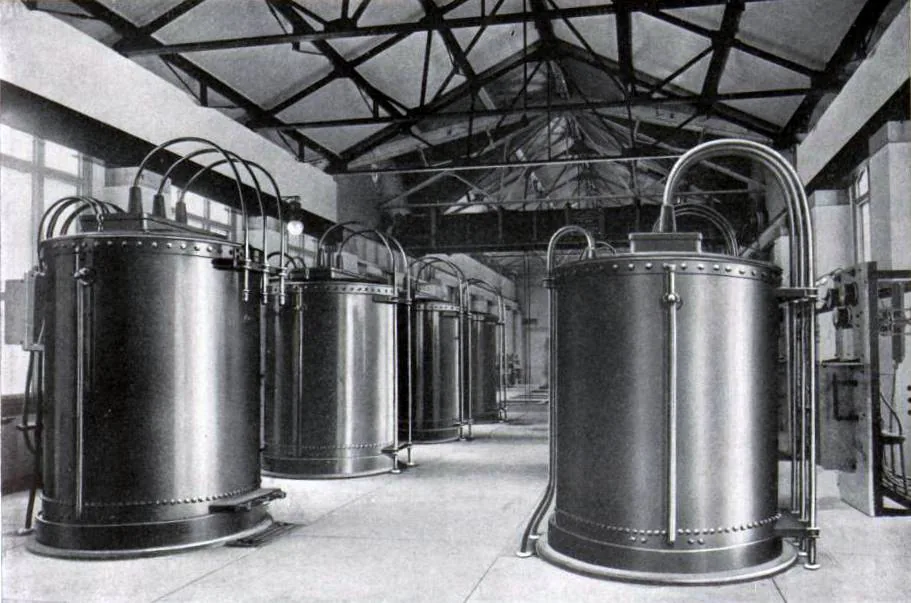

Direct current did not die; it was simply confined to the places where its economics still worked. Street railways, electrolysis, elevators and lifts kept it for decades. Consolidated Edison did not cut the last direct-current customers in Manhattan off the network until 14 November 2007, a hundred and twenty-five years after Pearl Street. And the largest long-distance links built today — undersea cables, continental interties — are high-voltage direct current, chosen for the same reason the fight was fought: at a high enough voltage, direct current is the arrangement that uses the least conductor.
What the story is actually about.
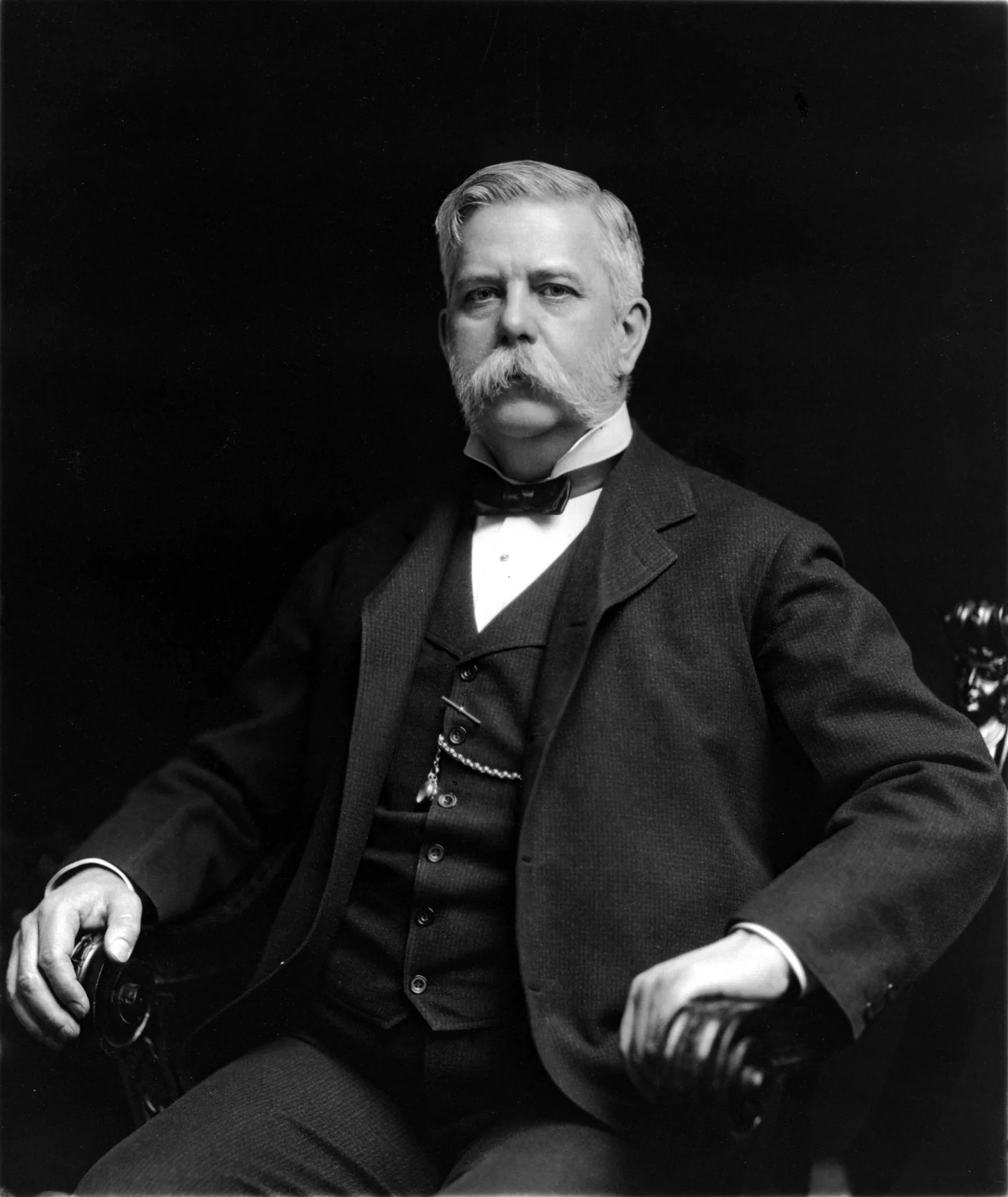

The version taught in schools has a hero, a villain and an elephant, and every one of those three is wrong. The antagonist across the table from Edison was George Westinghouse, an inventor and manufacturer of comparable stature who is missing from the popular account entirely. Tesla's contribution was real, specific and decisive — the motor that closed the last technical objection to the alternating system — and he made it as a patentee licensing a portfolio, not as a duellist. The elephant was killed for other reasons in a different decade by people Edison had never met.
What is left when those are removed is better than what they replaced. Two firms with incompatible balance sheets fought over a physical constant: the fact that the metal in the ground scales as the square of the distance and the inverse square of the voltage. One of them had a device that could change the voltage. That is why the argument ended the way it did, and it is why the ugliest episodes — the dogs, the calves, the chair — happened on the side that could not change it.
The documents
US 274,290 — System of Electrical Distribution. Filed 27 November 1882, granted 20 March 1883. Edison's three-wire system, and its own statement of the copper motive.
A Warning from the Edison Electric Light Company, 83 pages, ca. March 1888 — in the Thomas A. Edison Papers digital edition, folder CA019-F, the Edison Electric Light Co. printed matter for 1887–1889. Edison's letter to Southwick of 19 December 1887 is elsewhere in the same edition, at LB026116.
In re Kemmler, 136 U.S. 436 (1890). Argued 20 May 1890, decided 23 May 1890 — the bound volume of the United States Reports, scanned by the Library of Congress.
Thomas A. Edison, “The Dangers of Electric Lighting,” and George Westinghouse Jr., “A Reply to Mr. Edison,” The North American Review 149, nos. 396 and 397 — November 1889 and December 1889.
All are public documents, and every one is linked above to the archive that holds it. The patent list for the polyphase motors is at /patents/.
Notes
- Pearl Street Station, 255–257 Pearl Street, in service 4 September 1882; six 100 kW “Jumbo” dynamos, 600 kW total, each rated for 1,200 lamps; 110 V DC; 400 lamps on the opening day, in the offices of 82 customers by some accounts and 85 by others; 508 customers and 10,164 lamps by 1884. ↩
- London Metal Exchange price, £39 a ton at the beginning of October 1887 and £80 by December under the Secrétan syndicate. The sterling figure in the text is the tonnage above, converted to long tons, multiplied by that price; it is arithmetic, not a quoted historical cost. ↩
- Thomas A. Edison, System of Electrical Distribution, US Patent 274,290, application filed 27 November 1882, granted 20 March 1883. Dates transcribed from the patent face. ↩
- Westinghouse bought the American rights to the Gaulard–Gibbs secondary generator in the summer of 1885 after sending Guido Pantaleoni to report on it, and imported transformers and a Siemens alternator to Pittsburgh. ↩
- The Great Barrington system was placed in operation on 6 March 1886 and the two weeks following were spent on adjustment; the public demonstration is dated 20 March. Six step-down transformers in Main Street basements lit twenty business premises. IEEE Milestone, Alternating Current Electrification, 1886. ↩
- Buffalo, 30 November 1886: a Westinghouse single-phase 400-lamp system with a 1,000-volt primary, the generator sited in the Brush Electric Light plant at Wilkeson and Mohawk Streets. The station count is for the autumn of 1887, from the Edison company's own alarmed correspondence: 68 Westinghouse stations in operation or contracted for, against 121 of Edison's. Figures quoted at the time for later years vary wildly and are not repeated here. ↩
- The July 1888 licence is undisputed and the horsepower royalty appears in every account of it. The cash and stock components do not agree between published accounts, so no figure for them is printed here. ↩
- The Secrétan corner ran from October 1887 to March 1889 through the Société Industrielle et Commerciale des Métaux, on an initial credit of £2,500,000 from the Comptoir d'Escompte, with the Paris Rothschilds, the Crédit Lyonnais and the Banque de Paris et des Pays-Bas following it in. On 5 March 1889 the Comptoir's managing director killed himself; a run followed, and both the Société and the Comptoir were liquidated. Slade, cited below, puts the syndicate's share of new supply at 80 per cent and its effect on the LME price at a doubling. ↩
- Brown's letter is dated 5 June 1888 and is quoted in the same words across the secondary literature on the controversy, including the standard business-history treatment of Brown in Business History Review. ↩
- Columbia College School of Mines, 30 July 1888; Brown returned four days later with three more dogs to answer the objection that the first animal had been weakened by the direct current. West Orange, 5 December 1888: a 124 lb calf killed at 770 V after surviving 1,100 V through a faulty transformer, a 145 lb calf at 750 V, and a 1,230 lb horse at 700 V after 600 V twice failed. Kennelly's notes record that the animals suffered; Brown's published report called all three deaths instantaneous and painless. Accounts giving four calves are not supported by the notes of the day. ↩
- A Warning from the Edison Electric Light Company, 83 pages, dated ca. March 1888 in the Edison Papers finding aid for folder CA019-F; other accounts date the printing to February. Either way it precedes Brown's June letter. ↩
- Thomas A. Edison, “The Dangers of Electric Lighting,” The North American Review 149, no. 396 (November 1889); George Westinghouse Jr., “A Reply to Mr. Edison,” ibid. 149, no. 397 (December 1889), pp. 653–664. ↩
- The New York Sun printed forty-five letters taken from Brown's office in August 1889, showing payments and instructions from Edison Electric and from Thomson-Houston. ↩
- Edison to Alfred P. Southwick, 19 December 1887, letterbook document LB026116 in LB-026 (August 1887 – November 1888), Thomas A. Edison Papers. It is the letter in which Edison names the “alternating machines” and their manufacturer. ↩
- Brown asked the Edison laboratory for the money to buy the alternators and obtained three of them indirectly for the state prisons. ↩
- In re Kemmler, 136 U.S. 436 (1890), No. 13 Original, argued 20 May 1890 and decided 23 May 1890, Fuller C.J.; the page and dates are as printed in the bound United States Reports. The opinion was delivered by Chief Justice Fuller. The crime was committed 29 March 1889; conviction 10 May 1889; sentence 14 May. ↩
- Part IV opens on page 16 of the May 1919 issue — volume 7, number 1 — and is carried over to pages 64–65 at the back of the book. The Edison Machine Works passage is on page 65, and is quoted here from the scanned issue rather than from a later reprint. ↩
- The “American humor” line appears in John J. O'Neill, Prodigal Genius: The Life of Nikola Tesla (1944), a narrative biography published the year after Tesla's death. It is not in My Inventions, and no earlier printing of it has been located. ↩
- Thomas A. Edison Papers, Rutgers University, “Myth Buster: Topsy the Elephant.” ↩
- Contemporary reports claimed three deaths over three years, and some claimed as many as twelve. The Brooklyn death of J. F. Blount in May 1902 is documented; a book-length reconstruction of the circus and newspaper record — Michael Daly, Topsy: The Startling Story of the Crooked-Tailed Elephant, P. T. Barnum, and the American Wizard, Thomas Edison (2013) — found no record supporting the others. ↩
- The Cataract company adopted polyphase alternating current on 6 May 1893 and placed the contract for three 5,000 hp two-phase generators with Westinghouse on 26 October 1893. Adams station No. 1 supplied its first commercial power on 26 August 1895, to the Pittsburgh Reduction Company's aluminium works next door; transmission to Buffalo began on 15 November 1896. IEEE Milestone, Adams Hydroelectric Generating Plant, 1895. ↩
Sources — primary documents
- Edison, System of Electrical Distribution, US 274,290, granted 20 March 1883.
- Tesla, Electro-Magnetic Motor, US 381,968, and Electrical Transmission of Power, US 382,280, both granted 1 May 1888 on the application of 12 October 1887; the second was divided out of the first on 9 March 1888.
- A Warning from the Edison Electric Light Company, ca. March 1888: Thomas A. Edison Papers digital edition, folder CA019-F. Edison to Southwick, 19 December 1887: LB026116.
- Thomas A. Edison, “The Dangers of Electric Lighting,” The North American Review 149, no. 396, November 1889.
- George Westinghouse Jr., “A Reply to Mr. Edison,” The North American Review 149, no. 397, December 1889, pp. 653–664.
- In re Kemmler, 136 U.S. 436 (1890), argued 20 May and decided 23 May 1890, in the official United States Reports.
- Nikola Tesla, “My Inventions IV: The Discovery of the Tesla Coil and Transformer,” The Electrical Experimenter 7, no. 1 (May 1919), pp. 16–17, 64–65 — volume 7 at the Internet Archive.
Sources — further reading
- Thomas A. Edison Papers, Rutgers University: “The Current Wars” and “Myth Buster: Topsy the Elephant”.
- Terry S. Reynolds and Theodore Bernstein, “Edison and ‘The Chair’,” IEEE Technology and Society Magazine, March 1989 — a technical reading of the electrocution episode.
- Harold C. Passer, “Harold P. Brown and the Executioner's Current: an Incident in the AC–DC Controversy,” Business History Review 28, no. 2 (1954) — the standard account of Brown's backing.
- IEEE Milestones: Alternating Current Electrification, 1886 (Great Barrington) and Adams Hydroelectric Generating Plant, 1895 (Niagara).
- Early Electrification of Buffalo, Engineering and Technology History Wiki, for the November 1886 Westinghouse station.
- Margaret E. Slade, “Vertical Restraints Imposed by Buyers: the Secrétan Copper Cartel, 1887–1889,” Antitrust Law Journal 83, no. 1 (2020), pp. 75–97 — the copper corner in detail, with the London price series.
The record so far
- False “Edison electrocuted an elephant to discredit Tesla.” Topsy was killed at Luna Park on 4 January 1903 by the park's owners, thirteen years after Kemmler and eleven after Edison left the lighting business. His manufacturing company filmed it, and the film is the whole of the connection.
- Source is Tesla alone “Edison promised Tesla $50,000 and laughed at him when he asked for it.” The promise is attributed to “the Manager” in Tesla's own account of 1919. The laughing line comes from a 1944 biography and is not in the 1919 text.
- True but misattributed “Tesla won the war of the currents.” Alternating current won it. The company that fought and paid for it was Westinghouse Electric; Tesla licensed the motor patents to it in July 1888 and took a royalty. What the polyphase patents actually claim
Read next
-
1885–1893 · The polyphase patents
Did Tesla invent alternating current?
He did not, and the thing he did invent is more specific and more interesting than the thing he is credited with.
-
What the tower at Shoreham was for
The contract J. P. Morgan signed in March 1901 bought transatlantic wireless telegraphy, and the plant that ran the tower burned coal.