The boat that obeyed him
A vessel that started, steered, lit its lamps and fired a charge on command, with nothing at all connecting it to the man giving the orders. The patent says how.
The document
PATENT — US 613,809, Method of and Apparatus for Controlling Mechanism of Moving Vessels or Vehicles.
DATES — Application filed 1 July 1898, Serial No. 684,934. Granted 8 November 1898. Five sheets of drawings, thirteen claims, no model filed.
STATUS — Public domain, and long expired: under the law then in force a United States patent ran seventeen years from grant, so it lapsed on 8 November 1915.
Most claims about Nikola Tesla shrink when you open the document behind them. This one grows. US 613,809 is thirteen claims and five sheets of drawings describing a boat that started, stopped, put its rudder over, lit coloured lamps and fired a charge, in answer to a man standing somewhere else with a switch and no wire running anywhere. It was filed on 1 July 1898 and granted four months later. It is free to read, and it is specific enough to build from.
The problem, as the patent states it.
The specification opens by defining the job rather than boasting about it: the problem is “that of controlling from a given point the operation of the propelling-engines, the steering apparatus, and other mechanism carried by a moving object, such as a boat or any floating vessel.”1 Directed vessels already existed, and the patent says so: the only earlier successes “have been made in connection with a certain class of vessels the machinery of which was governed by electric currents conveyed to the controlling apparatus through a flexible conductor”, limited by “the length, weight, and strength of the conductor which can be practically used”.2 That is the wire-guided torpedo of the previous twenty years. Claim 1 strikes the wire out and puts nothing in its place but the air, the water and the ground: waves “which are conveyed to the vessel by the natural media”.
The ear.
Every wireless receiver of the period turned on the same fragile trick. A tube of loose metal filings has a high resistance until an electrical wave passes through it; then the grains cling together, the resistance collapses, and a battery current flows that can work a relay. Édouard Branly published the effect in 1890 and Oliver Lodge gave the device its name, the coherer. Its defect is its virtue: once the grains have clung they stay clung, so something must jar them apart before the next signal, and they settle a little differently each time. Sensitivity therefore wanders from signal to signal — tolerable for an operator reading dots and dashes by ear, useless for a machine that has to count.
Tesla's answer occupies claims 9 to 11 and is the least famous good idea in the document. First he made the grains identical — “manufactured by a special tool, insuring their equality in size, weight, and shape”, then “uniformly oxidized by placing them for a given time in an acid solution of predetermined strength”, then sealed dry, because moisture “is fatal to satisfactory working”. Then, instead of tapping the tube, he turned the whole receptacle end for end, so the grains fall its length and settle afresh: “inasmuch as they always fall through the same space and are subjected to the same agitation they are brought after each operation of the relay to precisely the same electrical condition.”3 A detector that returns to a known state after every signal is a detector you can count with, and everything else in the boat depends on that sentence.
One signal, made to mean several things.
Here is the difficulty that makes the patent interesting. Tesla had one transmitter producing one kind of disturbance, and the boat could tell that an impulse had arrived and nothing else. Six functions had to be driven from a channel one bit wide.
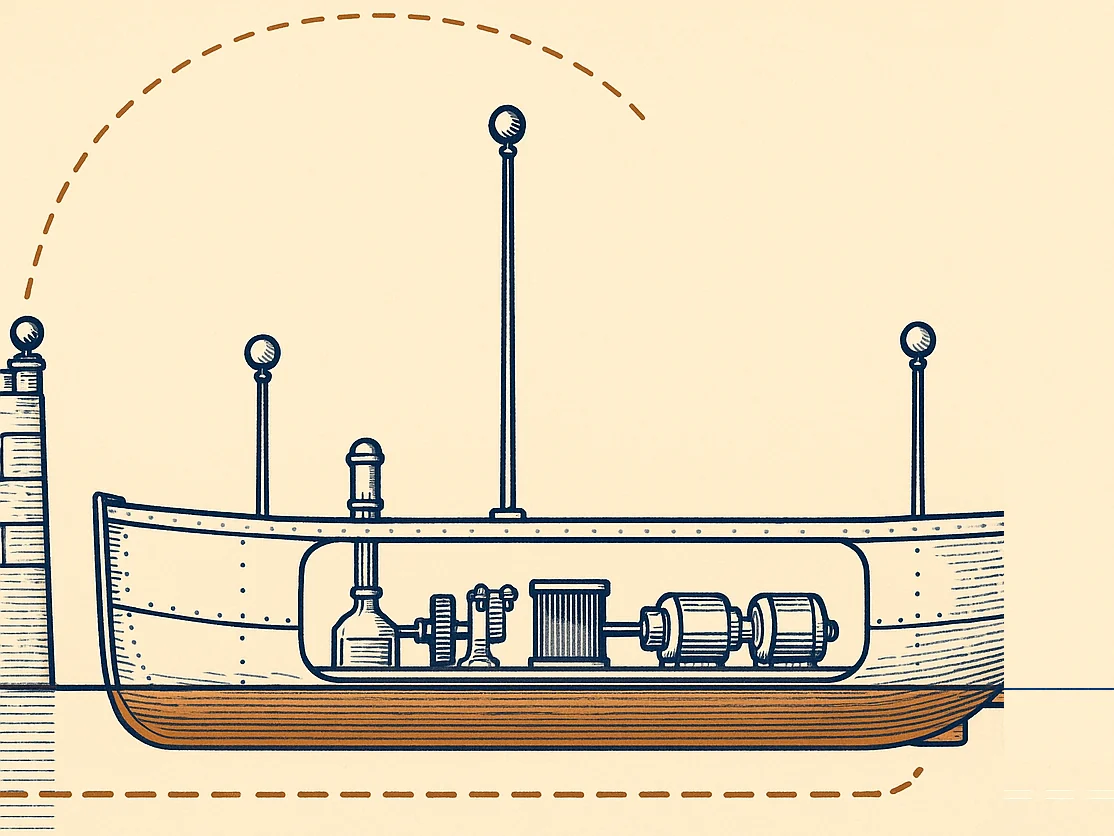
He solved it with clockwork. Each impulse closes relay a, which energises magnet f, whose armature releases an anchor escapement holding a spindle driven by a clock train, “so that for each oscillation of the escapement the spindle is turned through one-quarter of a revolution”. On that spindle sits a cylinder carrying two contact segments on opposite sides with insulating gaps between them, so a brush riding on it closes relay K′, then nothing, then K″, then nothing, then round again — and those relays drive the steering motor one way or the other.4 The shore end matches it exactly: the switch handle is “movable in one direction only” and stops on four points, and every move from stop to stop sends one impulse. The operator does not choose a command. He advances the boat one place in a cycle his own dial shares with it. The rudder then turns a disk of contacts under six brushes, and that disk edits the orders the boat will accept: past “conveniently forty-five degrees from the center position” the steering motor can only be run back the other way, and at a wider angle still the brushes leave the long segments and stop the propelling motor outright.
Then the second channel, which is cleverer still and costs nothing. A small motor m sits in series with the steering motor, always turning the same way, opposed by a spring. Ordinary steering closes that circuit briefly and the spring pulls it back; but a rapid series of impulses — which cancel at the rudder, driving it alternately each way — winds motor m on through a clock train until a lever touches a plate and lights the lamps, and, driven further, a post that closes the circuit of “a device o”, the patent's discreet name for the charge.5 One channel, a four-state counter and a timer, and out of them six controllable functions. Writing under his own name in the New York Journal that November, Tesla said it was no more mysterious than the messenger call-box on an office wall, where one turn of the crank brings a boy, a further turn a policeman, and a full turn the fire brigade.6
Because the functions sit in a fixed order on the cylinder, the operator cannot pick one and execute it; he has to step round to it. In the vocabulary engineers settled on later, the 1898 boat is radio-controlled rather than remote-controlled, since remote control implies distinct signals for distinct commands.7 The distinction makes the achievement larger, not smaller.
What the boat was.
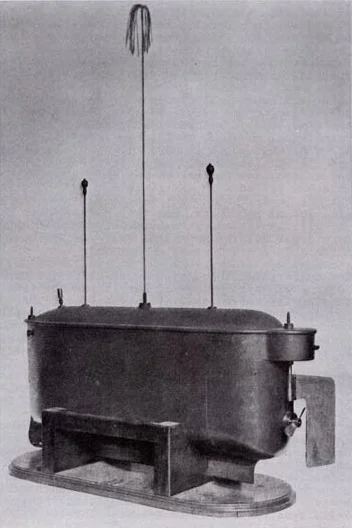
The patent gives no dimensions, which is worth saying, because the figures quoted for the model in modern accounts are not in it. What it does specify is the hardware: storage batteries, a screw-propeller on the shaft of the propelling motor, a small steering motor worm-geared to the rudder, the receiver and its clockwork, and the metal keel of the vessel doing duty as the earth connection for the receiving circuit. On deck stand the standard carrying the elevated terminal and two more carrying lamps, which the specification asks to have “painted in lively colors, so as to be visible by day at great distances”, the lamps themselves coloured, so that flashing them reads the rudder's position back at night. The compartment in the hull is left deliberately vague — it may carry “objects of any kind, according to the nature of the uses to which it is to be applied” — and the only place the charge is named is that unlabelled “device o”. A visitor to the Houston Street laboratory described a demonstration for the New York Herald on 8 November 1898, the day the patent issued: “he gave the lever a sharp turn. Instantly the little bronze propeller began to revolve at a furious rate… another quick movement of the lever sent the helm sharp over… At another signal the screw stopped and reversed.”8 A second, larger telautomatic boat followed, Tesla wrote in 1919, its hull “made entirely water-tight and capable of submergence” and controlled by loops laid inside it rather than by an aerial.

Where it was actually shown.
The story everyone repeats is that Tesla demonstrated the boat in September 1898 at the Electrical Exhibition in Madison Square Garden, before a crowd that took it for a trick. Three things are wrong with it.
That exhibition was in May, not September, and its wireless sensation was not Tesla's. It belonged to W. J. Clarke of the United States Electrical Supply Company, who blew a miniature Spanish cruiser out of the Garden's fountain lake with a wirelessly fired mine four times a day; the New York Times described the first public showing on 7 May and reported on 24 May that a charge forgotten in a desk drawer had gone off in sympathy, reducing the desk “to kindling wood”.9 Second, no contemporary notice has been found putting Tesla's boat in that hall. Carlson's biography, working with the archives of the Nikola Tesla Museum in Belgrade, could not locate one, and notes that Tesla may not yet have had a boat that would swim in May — the patent application was still two months away.10 Scholarship since has gone on asserting it anyway: a 2021 study of the press reception opens by stating flatly that Tesla gave the first public display at the Garden in May 1898, and illustrates the passage with the photograph the Century printed in 1900.11 Third, the official history of United States naval communications puts the 1898 demonstration “at the Auditorium in Chicago”. That is very likely a year misplaced: Tesla did show the boat in Chicago, to the Commercial Club, in May 1899, on his way to Colorado Springs.12 Four accounts, four settings, and only one of them rests on a source written in 1898.
That one is the laboratory. Tesla showed the boat at 46 East Houston Street to reporters and visitors, and the surviving descriptions, along with his own article in the New York Journal of 13 November 1898, date from that fortnight. His account of how audiences took it corrects the version in which he mystified people and never explained: “the visitors were requested to ask any questions, however involved, and the automaton would answer them by signs. This was considered magic at that time but was extremely simple, for it was myself who gave the replies by means of the device.”13 Under oath in 1916 he described the obvious suspicion and how he met it: “I would open it and show that there was no one inside; it was just a little box filled with instruments.”14
The detail usually attached here — that spectators decided a trained monkey was steering from inside the hull — has not been located in any source from 1898 and circulates only in modern retellings. The attested suspicion is the plainer one, of a small hidden operator, and it is the one he answered by lifting the deck. A second claim belongs to him alone: that the Patent Office would not credit the application until “the Examiner-in-Chief had come to New York and witnesst the performance, for what I claimed seemed unbelievable”. That appears in his autobiography of 1919 and nowhere earlier that has been located. Source is Tesla alone
Why the Navy passed.
The professional reception was cold, and it was printed where it would do the most damage. Thomas Commerford Martin, who had been Tesla's own editor and champion, used the Electrical Engineer of 17 November 1898 to canvass opinion against him. He quoted Cyrus F. Brackett of Princeton: “There is nothing new about [Tesla's patent]. The theory is perfect, but the application is absurd… what is new about it is useless, while that which is useful had all been discovered by other scientists long before Tesla made this startling announcement.”15 Carlson, quoting the Herald, has Brackett pressing the practical half of that harder — could “minute and carefully adjusted mechanical experiments… which require the quiet of an uninterrupted laboratory” be worked in the din of battle? Amos Dolbear of Tufts skipped the apparatus and went for the man: Tesla “has made so many startling announcements and has performed so few of his promises that he is getting to be like the man who called ‘Wolf! wolf!’ until no one listened to him.”16
Dolbear was scoring a point. Brackett's first half — that there was nothing new here — is hard to square with claim 1, which no earlier granted American patent matches. His second half was right, and it is the one that mattered. A single-frequency coherer answers any disturbance strong enough to break down its dielectric film, and a battle is full of them; the patent admits the risk and offers close tuning as the remedy, “chiefly with the object of preventing the receiving-circuit from being affected by waves or disturbances emanating from sources not under the control of the operator”. Worse, the control system is a counter: one spurious impulse and the operator's dial and the boat's commutator disagree, discoverable only by looking at the boat — which he has to see in any case.
What Tesla offered the public that November made it worse. Not the model on the laboratory bench but a thirty-six-and-a-half-foot submarine destroyer carrying six fourteen-foot Whitehead torpedoes, buildable, he said, “for $48,000 to $50,000 or less”, and able to destroy a whole armada in an hour. None of it existed. His friend Richmond Hobson pressed the boat on the Navy in 1902; senior officers looked and it went no further.17 Tesla's memory of Washington was that the official he approached “burst out in laughter upon my telling him what I had accomplished”.
The rest of the record is the part that gets left out. Tesla took the interference objection seriously and answered it. In applications filed in July 1900 and June 1901 — issued as US 725,605 and US 723,188 — he claimed a receiver with two circuits tuned to two different classes of disturbance, operating only on “their conjoint or resultant action”: “if through any extraneous disturbance only one of the circuits at the receiving-station is affected the relay R will fail to respond.” That is an AND gate built out of tuned circuits, and the first serious answer anyone gave to jamming. The Navy's own historian credits it without hedging: of the system the United States eventually bought, “the Hammond system used dual-channel transmission, a type originally proposed and patented by Tesla.”18
The Navy's timetable is its own comment. Congress appropriated $750,000 on 6 July 1916 for the exclusive rights to John Hays Hammond Jr.'s radio-dynamic control of waterborne carriers of high explosives. A joint board watched an unmanned boat controlled from a shore station and from an aircraft in flight at Fort Monroe on 23 August 1918, called the demonstration successful, and then told Hammond on 31 October that it could not report favourably and wanted a fully submerged torpedo instead; the Coast Artillery abandoned its half of the project in July 1921, aircraft bombing having overtaken it; the contract was not concluded until 30 July 1932, thirty-four years after the patent issued. Howeth's own footnote supplies the epitaph: no radio-directed submerged torpedo was ever used to sink a ship. The service did not fail to see the idea. It spent a third of a century failing to turn it into a weapon, which explains 1898 better than anybody's stupidity does.
About “the first drone”.
Restraint is owed here, and a narrow claim survives it. US 613,809 is the earliest United States patent located here that claims the control of a vehicle's own propelling and steering machinery by waves through the natural media, with no conductor of any kind running to it. That is a real first, and it is not the same as the first wireless control of anything, nor even a settled priority. Ernest Wilson and Charles John Evans of London filed in Britain on 29 December 1897 — six months before Tesla filed — and were granted US 663,400 for controlling mechanism by high-frequency waves on 4 December 1900. Bradley A. Fiske, a serving American naval officer, filed for US 660,155 and 660,156 on 7 September 1898, nine weeks after Tesla, and the Navy's own history nonetheless describes them as “both underlying Tesla's”.19 Nor is this the ancestor of remote control as now practised: Leonardo Torres Quevedo's Telekino, patented across four countries in 1902 and 1903, was the first to send genuinely distinct orders rather than steps in a cycle, and in 1906 he took full control of a dinghy with a crew of eight in the Bilbao estuary from more than two kilometres away.20 The line from 1898 to a modern uncrewed aircraft does not run through this hull. It runs through the whole of radio. Lineage, not descent.
What is his outright is the idea, written out in the Century in June 1900. The machines built so far, he said, had “borrowed minds”, each one “merely formed part of the distant operator who conveyed to it his intelligent orders”; the thing to build next was an automaton “which will have its ‘own mind’”, able, “left entirely to itself, to perform… a great variety of acts and operations as if it had intelligence”.21 He had a word for the field, and it did not catch on: telautomatics.
There is nothing to deflate here. A man with no vacuum tube, no amplifier and one bit of bandwidth built a receiver that returned to a known state after every signal, a counter to give that signal an address, and a timer to give it a second meaning — then wrote it down in enough detail for a competent shop to reproduce it. The document is five sheets long, it costs nothing, and it opens in one click.
Search log
VENUE — unresolved, and reported as unresolved. Four settings appear in print for the first public demonstration: Madison Square Garden in September 1898 (most popular accounts), Madison Square Garden in May 1898 (the correct date of that exhibition, and the date given without a contemporary citation in the 2021 study), the Chicago Auditorium in 1898 (the 1963 US Navy history), and the Houston Street laboratory (the contemporary press of November 1898). Only the last is supported by a source of 1898. No contemporary notice placing the boat at the Garden was located.
TRAINED MONKEY — earliest trace not located. No source of 1898 examined here mentions it. The attested suspicion is a concealed human operator, which Tesla answered by opening the hull.
PORT OR STARBOARD — the specification contradicts itself. In the general description relay K′ “is rotated in a direction to throw the rudder to port” and K″ “shifts the rudder to starboard”; in the worked example that follows, moving the handle from u′ to t energises K″ and “motor F is thus set in operation to shift the rudder to port”, while t′ and K′ give starboard. The two passages cannot both be right, so the diagram above labels the stops without assigning sides.
NOT CONSULTED DIRECTLY — the Electrical Engineer of 17 and 24 November 1898, the New York Herald of 8, 9 and 10 November 1898, Carlson's Tesla, and the patent file wrapper. Quotations from those are taken at second hand and marked as such in the notes.
FIGURES NOT IN THE PATENT — the model boat's length and hull material, widely given as about four feet and iron, appear nowhere in US 613,809, which states no dimensions. They are not repeated here.
The record on this article
- Confirmed “Tesla patented a wireless remote-controlled boat in 1898.” US 613,809 was filed 1 July 1898 and granted 8 November 1898. The receiver, the stepping mechanism and the six controlled functions are all described in the specification, and the boat was shown working to reporters that November.
- Not established “He demonstrated it at Madison Square Garden in September 1898.” That exhibition ran in May 1898, its wireless attraction was another man's radio-fired mine, and no contemporary notice placing Tesla's boat in the hall has been located, by his biographers, by the Tesla Museum, or here. Later accounts state it anyway, without citing one. The documented demonstrations are laboratory ones, from 8 November 1898.
- Source is Tesla alone “The Patent Office refused to believe it until the Examiner-in-Chief came to New York to watch.” The account appears in his autobiography of 1919 and has not been located in any earlier source.
Sources
Primary documents
- Method of and Apparatus for Controlling Mechanism of Moving Vessels or Vehicles, US Patent 613,809, filed 1 July 1898, granted 8 November 1898. A clean transcription of the full specification and all thirteen claims is also published by Tesla Universe.
- System of Signaling, US Patent 725,605, filed 16 July 1900, granted 14 April 1903, and Method of Signaling, US Patent 723,188, filed 14 June 1901, granted 17 March 1903 — the two circuits acting conjointly.
- “Tesla's New Submarine Destroyer”, New York Journal and Advertiser, 13 November 1898, reprinted in full — his own account, including the messenger call-box analogy and the $48,000 destroyer.
- The Problem of Increasing Human Energy, Century Illustrated Magazine, June 1900, full text at Wikisource — the “borrowed mind” passage and the case for telautomatics.
- My Inventions, VI: “The Art of Telautomatics”, Electrical Experimenter, October 1919, scanned issue (PDF).
- Linwood S. Howeth, History of Communications-Electronics in the United States Navy (Washington: Bureau of Ships and Office of Naval History, 1963), chapter XXIX, “Remote Radio Control”, 337–51 — the official account of the 1916 appropriation, the 1918 board, and the contract of 30 July 1932.
- “Accident in the Garden”, New York Times, 24 May 1898, reprinted here — the Electrical Exhibition's wireless mine, and its misfire.
- US Patent 663,400 (Wilson and Evans; British application 29 December 1897, US filing 28 July 1898, granted 4 December 1900) and US Patents 660,155 and 660,156 (Fiske, filed 7 September 1898) — the neighbouring claims, with the dates that settle the order.
Further reading
- W. Bernard Carlson, Tesla: Inventor of the Electrical Age (Princeton University Press, 2013), chapter 12 and its notes — the fullest treatment of the boat, including the finding that no evidence places it at the Madison Square Garden exhibition.
- Thomas H. White, “William J. Clarke and the United States Electrical Supply Company”, in United States Early Radio History, section 7 — what the Garden's wireless demonstration actually was, and why the newspapers overstated it.
- IEEE Milestone, “Early Developments in Remote-Control, 1901”, on Torres Quevedo's Telekino and the Bilbao trial of 25 September 1906.
- Daniel Wuebben, “Of robots and rhetoric: Nikola Tesla's telautomaton and the boundaries of scientific communication (1897–1900)”, Public Understanding of Science 30:4 (2021), 484–92, author's copy, open access — the press reception, issue by issue. Read it against Carlson on the question of where the boat was first shown; the two disagree, and only one of them says why.
- Kendall Milar Thompson, I, Robot: Nikola Tesla's Telautomaton (doctoral dissertation, University of California, 2015), eScholarship qt4xr9r7rm.
Notes
- US 613,809, specification, second paragraph. ↩
- US 613,809, specification, same paragraph. The objections listed are “the length, weight, and strength of the conductor which can be practically used”, the difficulty of high speed and rapid course changes, and the need to control from a point “which is practically fixed”. ↩
- US 613,809, specification, on the preparation of the particles and on the inverted receptacle; claims 9, 10 and 11 cover the sensitive device and the escapement that permits it a half revolution. ↩
- US 613,809, specification: the anchor escapement g, the disk g″ with four pins on the spindle, the commutator cylinder j with segments j′ and j″, and relays K′ and K″ driving the steering motor F in opposite directions. The switch-box T and its four stops t, t′, u, u′ are described in the discussion of Fig. 9. The rudder's disk L′ carries two circles of contacts under six brushes: the isolated plate 23 breaks the circuit of the steering motor F beyond “a predetermined angle, conveniently forty-five degrees from the center position”, and the short segments on the outer circle stop the propelling motor D when a brush passes onto them from the long segments 7 and 8. ↩
- US 613,809, specification, on motor m, the spring m′, the clockwork M, the plate n that lights the lamps and the post n′ that brings “a device o” into action. ↩
- “Tesla's New Submarine Destroyer”, New York Journal and Advertiser, 13 November 1898: “It is as simple as the messenger call to be found in almost any office.” ↩
- Carlson, Tesla, chapter 12, drawing the distinction and crediting it to Antonio Pérez-Yuste, “Early Developments of Wireless Remote Control: The Telekino of Torres-Quevedo”, Proceedings of the IEEE 96:1 (January 2008), 186–90. ↩
- New York Herald, 8 November 1898, quoted here at second hand from Carlson, Tesla, chapter 12, which cites the Tesla Collection 13:138–40. ↩
- “New Way to Fire Mines”, New York Times, 7 May 1898, page 12, reporting “the first public exhibition” of the previous afternoon and stating that “these exhibitions are given four times each day at the electrical show”; “Accident in the Garden”, New York Times, 24 May 1898, page 11. ↩
- Carlson, Tesla, chapter 12, note 41: “Several biographies assume that Tesla must have displayed his boat at the Madison Square Garden exhibition, but like the experts at the Tesla Museum, I have not been able to find any evidence to support this assumption.” ↩
- Daniel Wuebben, “Of robots and rhetoric”, Public Understanding of Science 30:4 (2021), 484–92, at 485: “In May of 1898, Tesla gave the first public display of his telautomaton submarine boat at the Electrical Exhibition at Madison Square Garden (Figure 1).” No contemporary source is cited for the setting, and Figure 1 is the photograph the Century printed in June 1900. ↩
- Howeth, chapter XXIX, section 1: “Nikola Tesla worked upon a similar control idea and, in 1898, built a working model which he successfully demonstrated at the Auditorium in Chicago.” For the Chicago showing that is documented, in May 1899, see Wuebben, 489, on the lecture to the Commercial Club, citing “Tesla's Visit to Chicago”, Western Electrician, 20 May 1899, 285. ↩
- My Inventions, VI, Electrical Experimenter, October 1919. Spelling as printed. ↩
- Tesla's testimony of 1916, printed in Leland I. Anderson (ed.), Nikola Tesla on His Work with Alternating Currents and Their Application to Wireless Telegraphy, Telephony, and Transmission of Power (Denver: Sun Publishing, 1992), 158. ↩
- T. C. Martin, “Tesla's Electrical Control of Moving Vessels or Vehicles from a Distance”, Electrical Engineer, 17 November 1898, 489–91, at 491, quoted here at second hand from Wuebben, 488. ↩
- New York Herald, 9 and 10 November 1898 (“Doubts Value of Tesla Discovery” and “Chary about Tesla's Plans”), quoted at second hand from Carlson, Tesla, chapter 12. ↩
- Carlson, Tesla, citing Hobson's letter of 6 May 1902 urging Tesla to bring the patents to the Navy's attention, and Anderson, Guided Weapons & Computer Technology, 134–35, for what became of it. ↩
- Howeth, chapter XXIX, sections 2 and 4. The appropriation figure, the date of 6 July 1916, the Fort Monroe demonstration of 23 August 1918, the adverse finding of 31 October 1918, the Coast Artillery's withdrawal in July 1921 and the contract of 30 July 1932 are all from that chapter, as is note 25, which records that looking back over naval history no single radio-directed submerged torpedo “was ever used to sink a ship”, though surface-type missiles “have been successfully utilized”. ↩
- Filing dates from the patents themselves: US 663,400 records a British application of 29 December 1897 and a United States filing of 28 July 1898; US 660,155 was filed 7 September 1898 and granted 23 October 1900. Howeth, chapter XXIX, section 1, is the source of the “underlying Tesla's” judgment, and in the same paragraph dates the Wilson and Evans boats on the Thames to 1887 — a decade too early, and contradicted by the December 1897 priority date on their own patent. The 1887 date is repeated widely; it should not be. ↩
- IEEE Milestone, “Early Developments in Remote-Control, 1901”, quoting Antonio Pérez Yuste and Magdalena Salazar Palma, “Scanning the Past from Madrid”, Proceedings of the IEEE 93:7 (July 2005), 1379–82: Torres Quevedo “successfully took full control of a dinghy with a crew of eight at distances of over 1.25 mi”. ↩
- The Problem of Increasing Human Energy, Century Illustrated Magazine, June 1900. ↩
Read next
-
1943 onward · The record since
The Supreme Court did not rule that Tesla invented radio
It held the broad claims of Marconi's tuning patent invalid on somebody else's priority, and said in terms that the patent behind his reputation was not before it.
-
Wireless power, and why “free energy” is not what he was selling
He proposed a way to move energy, never a way to make it — and the way he proposed does not work.