Wireless power, and why “free energy” is not what he was selling
He proposed a way to move energy, never a way to make it — and the way he proposed does not work.
The claim
CLAIM — “Tesla had a system that would have given the world free, unlimited energy.”
STATUS — FALSE. Every document in the scheme describes transmission. None describes generation.
EARLIEST TRACE — Tesla himself, in one speculative passage of his lecture to the Institution of Electrical Engineers in London, February 1892, predicting machinery driven by “a power obtainable at any point of the universe”. The reading that attaches that hope to the Colorado Springs station and the tower at Shoreham is later: newspaper interviews in the 1930s, then the post-war small-press and conference literature.
RESTS ON — Two paragraphs of speculation in an 1892 lecture, and a claim about cosmic rays made to a newspaper in July 1932. No patent, notebook entry, contract or measurement supports it.
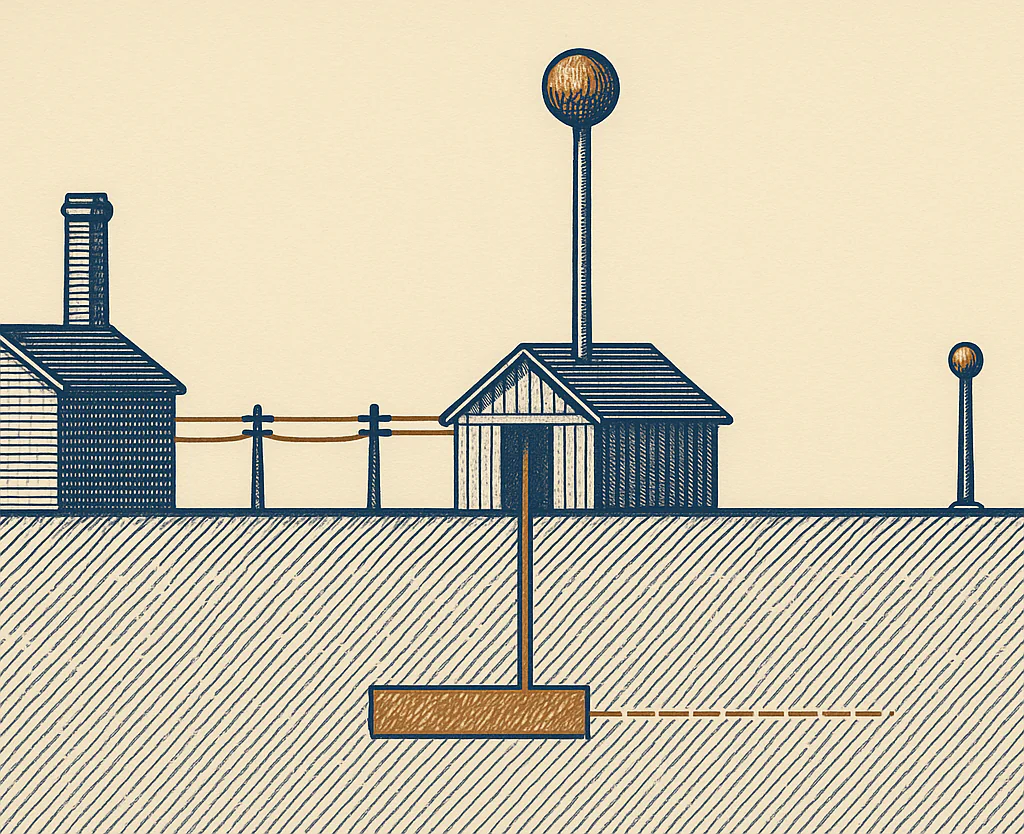
Almost every retelling folds two different things together: making energy, and moving it. Everything Tesla built at Colorado Springs, everything he patented afterwards and the tower he wanted at Shoreham belong to the second. The power was to come from somewhere ordinary — a hydroelectric plant, or a coal-fired one — and the invention was a way of delivering it with no copper in between. That is a transmission scheme, and an interesting one. Whether it would have worked is a separate question, and it has an answer: no.
The station on Knob Hill.
Tesla reached Colorado Springs in the third week of May 1899. Leonard E. Curtis, a patent lawyer, had found him land on Knob Hill — the high ground a mile east of downtown, between the school for the deaf and blind and the printers' home — and secured free current from the El Paso Electric Company. Free current is the detail to hold on to: the experiment remembered as a demonstration of limitless power was sited where it was because a utility agreed to give an inventor electricity for nothing.
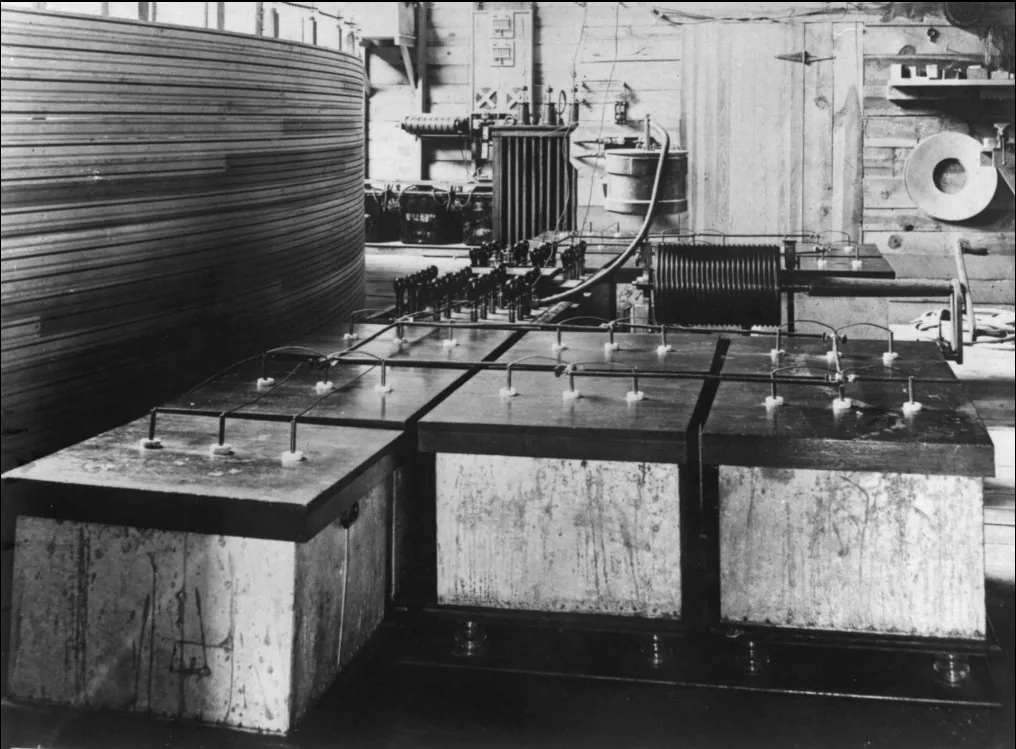
What went up was a barn-like wooden building roughly fifty by sixty feet, with a section of roof that rolled back, and a mast about 142 feet high carrying a wooden ball some thirty inches across, sheathed in copper foil. Inside, a primary winding about fifty feet in diameter ran around the wall, with a secondary inside it and, later, a third winding — the “extra coil” — resonant with the rest and joined at its top to the elevated terminal. Tesla called the arrangement a magnifying transmitter. The third coil raised the terminal to a very high potential at a chosen frequency without raising the voltage across the insulation of the first two: a real piece of engineering, and the same trick a Tesla coil performs on a lecture bench.
The notebook.
The record of that year survives in an unusually good form. Tesla kept daily notes — roughly five hundred pages of entries and close to two hundred drawings, dated from 1 June 1899 to 7 January 1900 — published in Belgrade in 1978 as Colorado Springs Notes, 1899–1900. A daily notebook is a different object from a memoir: it records the runs that failed on the day they failed, the spark lengths as measured rather than as remembered, and the opinions he held for a fortnight and dropped. Anyone arguing about that shed has a primary source, which is more than most of the disputed episodes in his life can offer.
The entry that matters most is from 3 July 1899. A thunderstorm passed over the station and moved away eastward, and his receiving instruments went on registering disturbances at regular intervals as the storm receded — the effect repeating, by his account, until the storm was some three hundred kilometres off. He concluded that he was detecting stationary waves: disturbances travelling outward through the earth, reflecting at the far side, and interfering with the outgoing ones to produce a fixed pattern of crests and hollows over the whole globe. That inference is the hinge of everything that follows. It is also the part of the record that has not held.
One smaller item belongs here, because the picture does more work in the popular account than any document does. The famous plate showing Tesla seated with a book while enormous discharges fill the room is two exposures: the discharge first, with the room empty, then the seated figure with the apparatus off. He said so in the notes, and published the image in The Century Illustrated Monthly Magazine in June 1900. It is not a forgery; it is a composite he described as a composite. His claim of discharges up to 135 feet long is a separate matter — no independent witness or measurement of that figure has been located. Source is Tesla alone
The generator.
The best-known Colorado Springs story is that Tesla ran the transmitter hard enough to black out the town. What is documented, in his own account in The Electrical Experimenter of August 1917, is narrower and technically more interesting: the dynamos in a power house six miles away were repeatedly burned out by the high-frequency currents his apparatus put into the supply, sparks driven through the windings and the insulation destroyed.
Whether the town went dark, and for how long, is less certain than the retellings suggest. A search of the readily available record turns up no contemporary Colorado Springs newspaper report of a city-wide outage attributed to the station, and the strongest primary statement remains Tesla's own, seventeen years late. How the bill was settled afterwards is not recorded either. The solid part is bad enough: the free electricity that made the experiment possible was being converted, at the far end of the line, into destroyed machinery belonging to someone else.

What happened to the station.
The last notebook entry is dated 7 January 1900. Tesla went back to New York to raise money for a larger installation, and the Colorado Springs station never operated again. He was sued locally for unpaid bills; the building was pulled down in 1904 and its timber sold off as building material, and the remaining contents were auctioned at the county courthouse two years after that. Four years after leaving a station said to have demonstrated unlimited power, the inventor could not satisfy a judgment of $180, and the building came down for lumber to pay it.
What the patent claims.
The clearest statement of the physical premise is US 787,412, Art of Transmitting Electrical Energy Through the Natural Mediums, filed on 16 May 1900 out of the Colorado Springs work, renewed on 17 June 1902 and granted on 18 April 1905. It is not a vague document. It says what it thinks the earth is:
“the terrestrial globe may in a large part or as a whole behave toward disturbances impressed upon it in the same manner as a conductor of limited size”
“the planet behaves like a perfectly smooth or polished conductor of inappreciable resistance with capacity and self induction uniformly distributed along the axis of symmetry of wave propagation”
US 787,412, granted 18 April 1905, specification.
Read the second one again. Inappreciable resistance is not a measurement. It is an assumption, and it is the one the entire scheme rests on. The patent goes on to describe oscillations communicated to the ground, propagated to distant parts of the globe, reflected there, and interfering with the outgoing vibrations to “produce stationary waves the crests and hollows of which lie in parallel circles”. A receiver tuned to the same period, connected to earth at a suitable point, draws its energy from that pattern. Nothing in the document creates energy; the apparatus is a delivery mechanism throughout.
The numbers he printed, and what they imply.
Four figures in the specification carry the argument. The disturbance is taken to travel “to and returning from the region diametrically opposite the pole over the earth's surface with a mean velocity of about four hundred and seventy-one thousand two hundred and forty kilometers per second”. The waves observed had lengths varying “approximately from twenty-five to seventy kilometers”. The frequency “should be smaller than twenty thousand per second”. And the wave train “should continue for a certain interval of time, which I have estimated to be not less than one-twelfth or probably 0.08484 of a second”.
Those numbers are internally consistent and they can be checked in a minute. Light travels at 299,792 kilometres per second in vacuum. Tesla's 471,240 is 300,000 multiplied by π/2 — 471,239 to the nearest kilometre per second — so the mean velocity he assumes is about 1.57 times the speed of light. He arrives at it geometrically, as an average for a disturbance spreading over a sphere rather than a claim about signalling faster than light, but it is the number that fixes everything downstream. Divide the earth's circumference, about 40,000 kilometres, by 471,240 and the answer is 0.0849 seconds, which is his 0.08484. The reciprocal of that interval — about 11.8 per second — is the fundamental his scheme implies for the whole planet. Keep that figure; it settles an argument later on.
What is wrong with treating the earth as a conductor?
Nothing, up to a point. The earth is used as a conductor every day: the return path in electric railways, the reference in every distribution network, the far electrode in geophysical survey work. Ground conducts. The question is not whether but how well, and the answer is a long way from “inappreciable resistance”. Crustal resistivity varies over orders of magnitude — a few ohm-metres in wet clay, hundreds to thousands in dry sand, granite and permafrost. The cross-section is enormous, which is why an earth return works at all; but the resistance of a real earth path is dominated by the region near the electrodes, where the current is crowded into a small volume before it spreads. That crowded volume is where the energy goes, as heat, and it does not come back.
Resonance does not rescue this. A tuned system builds a large oscillation from a small input repeated in step, but how large depends on the resonator's quality factor, and that falls as losses rise. A resonator whose conductor is wet clay and whose dielectric is thousands of kilometres of rock is not a high-Q resonator. Assuming a planet of inappreciable resistance is exactly the assumption that its Q is enormous. The assumption does all the work, and it is wrong.
Then there is the return path. The patent requires a conducting layer overhead, reached where the air is thin enough to break down. In 1900 no such layer had been detected. It had been guessed at — Balfour Stewart proposed conducting currents high in the atmosphere in 1882 to account for the daily wobble of the earth's magnetic field, and George Francis FitzGerald argued in 1893 that the upper air must conduct well — but the radio hypothesis proper arrived in 1902, published independently by Arthur Kennelly and Oliver Heaviside to explain how Marconi's December 1901 signal had crossed the Atlantic at all, and the layer was not demonstrated until Edward Appleton and Miles Barnett's fading measurements of December 1924 and Gregory Breit and Merle Tuve's pulse-echo work the year after. So Tesla built his return path on a conducting upper atmosphere a quarter of a century before anyone measured one, and it is up there. That is to his credit, and it is a lesson in what “he was right” can mean: being right that something is overhead is not the same as being able to push industrial power through it.
And the inverse-square law?
The standard objection is that radiated power spreads across an expanding wavefront, so its density falls as the square of the distance and a receiver collects only the fraction of that front it physically subtends. A dozen kilowatts leaving a transmitter arrive at a distant aerial as microwatts, and no amount of tuning creates energy the aerial never intercepted.
Tesla's answer was that this did not apply to him, because he was not radiating. He was explicit and repeated about it: his system worked by conduction and by resonance of the earth itself, not by the “Hertzian waves” his competitors used. Taking him at his word does not save the scheme, because the conduction case has its own loss law and it is not kinder. Propagation along a finitely conducting earth was worked out by Jonathan Zenneck in 1907 and Arnold Sommerfeld in 1909: a wave guided along real ground attenuates faster than geometric spreading alone, and the excess loss grows as frequency rises and ground conductivity falls. The low-loss surface-wave solution sometimes cited in Tesla's defence is a genuine solution of Maxwell's equations, but a vertical antenna on real ground couples into it very weakly, and a permitted mode is not the same as a mode you can excite from a mast.
One modern experiment settles the practical question, and it is not a simulation. The United States Navy built an extremely-low-frequency transmitter to reach submerged submarines — Tesla's regime exactly, using the earth and the ionosphere as the guiding structure. Two sites, in Wisconsin and Michigan, drove earthed antenna lines fourteen and twenty-eight miles long on a combined input of about 2.6 megawatts. Radiated power was on the order of eight watts: three parts per million of what went in. A three-letter code group took about fifteen minutes to send, which is one letter every five minutes. The system was declared operational in 1989 and the Navy ran it until 2004, so it worked.
That is the honest ceiling on the physics Tesla was reaching for, established with a century of additional engineering and a superpower's budget. It is a communications channel. It is not a power grid, and no amount of better hardware makes it one, because the loss is in the channel rather than in the machinery at either end.
Was he measuring the Schumann resonance in 1899?
This claim is stated as established fact throughout the modern literature: that the stationary waves Tesla detected in July 1899 were the earth–ionosphere cavity resonance, discovered by him half a century before it was named for someone else. It fails on chronology and on arithmetic, and the arithmetic is the interesting part.
The chronology first. Winfried Otto Schumann derived the resonance mathematically in 1952, in Zeitschrift für Naturforschung A; clean measurements waited for Balser and Wagner's observations, published in Nature in 1960 and refined over three years. The fundamental sits near 7.83 cycles per second. The concept postdates Tesla's death by nine years and his Colorado Springs summer by fifty-three. Whatever he thought he was observing, it was not this, because this did not exist to be thought about. Nor was he the first to reach for a global resonance: FitzGerald, in those 1893 remarks, put the period of oscillation of the earth and its conducting upper layer at about a tenth of a second — nearer the mark than the figure Tesla would print, though the work barely circulated.
Now the arithmetic. The idealised cavity fundamental is the speed of light divided by the earth's circumference: 299,792 divided by roughly 40,030 kilometres, or about 7.5 cycles per second — close to the 7.83 that is actually measured, the difference being the losses and the finite conductivity of the boundaries. Tesla's own published figure, worked out above from the specification of US 787,412, implies about 11.8. The two numbers differ by a factor of 1.57, which is the π/2 he inserted into his propagation velocity, carried straight through. Crediting him with the discovery of a 7.8-cycle resonance therefore requires throwing away the number he actually printed in the only place he printed one.
What can fairly be said is smaller and still to his credit. He was looking for a global electrical resonance, which is a real thing to look for, and where others speculated about it he built a station and instruments and went and looked. He did not find the one that is there, and the figure he published is not it. Retrofitting a 1952 result onto an 1899 notebook is a modern argument wearing period dress.
Where “free energy” came from.
The idea has a real ancestor, and it is Tesla. His lecture to the Institution of Electrical Engineers in London in February 1892 is a long technical account of high-frequency apparatus, single-wire lighting and what he called “no-wire” motors. About halfway through, having just described sending power through the rarefied upper air, he breaks off into this:
“But such schemes are mentioned merely as possibilities. We shall have no need to transmit power in this way. We shall have no need to transmit power at all. Ere many generations pass, our machinery will be driven by a power obtainable at any point of the universe. … Throughout space there is energy. Is this energy static or kinetic? If static our hopes are in vain; if kinetic — and this we know it is, for certain — then it is a mere question of time when men will succeed in attaching their machinery to the very wheelwork of nature.”
Experiments with Alternate Currents of High Potential and High Frequency, lecture before the Institution of Electrical Engineers, London, February 1892, in the section on “no-wire” motors.
Three things are worth noticing. He labels his own proposals “merely as possibilities” in the same breath. He does not claim the idea as his — “This idea is not novel,” he says in the next line; “Men have been led to it long ago by instinct or reason” — and the only working device he can point to is Crookes's radiometer, which he calls two sentences later the most inefficient machine ever invented. And he is describing a hoped-for future in which transmission becomes unnecessary, which is the opposite of a claim to have built a transmission system that makes its own power. Seven years later, the thing he actually built needed a utility to give it current, and burned out that utility's dynamos when it ran.
The 1930s are where the newspaper version begins. On 10 July 1932, his seventy-sixth birthday, the Brooklyn Eagle reported him saying: “I have harnessed the cosmic rays and caused them to operate a motive device.” No patent application followed, no demonstration was given, no apparatus was described in enough detail to build, no witness came forward. He gave the press several announcements of that shape in the decade, and the pattern holds: the announcement is documented, the device is not. This is where a transmission story becomes an energy-source story, and it happens in interviews rather than in filings.
After 1945 the account leaves the documentary record almost entirely and travels through small-press books and conference proceedings, where the Colorado Springs station becomes a working prototype, the tower at Shoreham becomes a source rather than a relay, and its demolition becomes a suppression. That reading needs two facts left out: that the agreement Morgan signed in March 1901 covered transatlantic wireless telegraphy, and that there was a coal-fired generating plant on the Shoreham site to run the thing.
The Pierce-Arrow. Unverifiable
The story runs like this. In 1931, in Buffalo, Tesla had the petrol engine taken out of a Pierce-Arrow and an alternating-current motor fitted in its place, driven not by batteries but by a box roughly twenty-five by ten by six inches holding twelve vacuum tubes, wired to a rod aerial about six feet long. The car was driven for a week at speeds up to ninety miles an hour, on power drawn from the ambient medium.
The provenance is a single thread. Every published version traces to a typescript circulated from the 1980s, summarising an interview of 16 September 1967 with a man named Petar or Peter Savo, described in it as a nephew of Tesla. The interview came thirty-six years after the events it describes, the summary at least fifty, and the Tesla family record contains no nephew of that name.
What is absent is more informative than what is present: no contemporary newspaper report in Buffalo or anywhere else, no Pierce-Arrow Motor Car Company record of the conversion, no entry in Tesla's correspondence, nothing in the Belgrade museum's holdings, no chassis, no motor and no box. A 1931 automobile running without fuel would have been the engineering story of the decade in a city built on automobiles, and the press of the period was, on the evidence of 1932, entirely willing to print whatever Tesla told it.
The correct status is unverifiable rather than false. A single second-hand recollection, recorded decades late and circulated decades after that, describing an object nobody has examined, is not evidence that the thing did not happen. It is an absence of evidence that it did, and collapsing that distinction is how a debunking becomes as sloppy as the myth.
What did survive.
Wireless power is not a failed field. It is a real, working, commercially deployed technology in three narrow forms, and the shape of those forms is the clearest possible statement of what the physics permits.
- Near-field induction. The Qi standard, published by the Wireless Power Consortium in 2010, moves power between two closely spaced coils at between 105 and 205 kilohertz. Its first version delivered up to five watts, with the coils about five millimetres apart. It is in a great many pockets. The working distance is millimetres because the coupling is magnetic and near-field, and it collapses as the coils separate.
- Resonant magnetic coupling. A group at MIT reported in Science in 2007 that they had transferred sixty watts across more than two metres at about forty per cent efficiency, using two self-resonant coils tuned to each other. This is the closest modern relative of Tesla's coil arrangement, and it stretches the useful range from millimetres to metres. The efficiency still falls away steeply with distance.
- Beamed microwave power. In 1975 an experiment at the Goldstone facility in California recovered more than thirty kilowatts of direct current from a 2.388-gigahertz beam over 1.54 kilometres, the receiving rectenna array converting what it caught at better than eighty-two per cent. The klystron behind the beam was fed some 450 kilowatts, so most of the energy never reached the array — but tens of kilowatts did, which is industrial power over a real distance. It works because the beam is aimed along a clear line of sight, which is exactly what Tesla's scheme was designed to make unnecessary.
None of the three uses the earth as a conductor. Two work because transmitter and receiver are effectively one magnetic circuit; the third works because the energy is pointed. The problem Tesla set — industrial power to any point on the planet, no wire, no line of sight — remains unsolved, and not because somebody bought the patents.
The verdict.
He was not a crank. Cranks do not print velocities, wavelengths and time intervals in granted patents, and they do not keep five hundred pages of dated measurements that anyone can go and read. The wireless-power scheme can be called wrong, rather than merely doubted, precisely because Tesla made it checkable. The premise under all those numbers is an assumption dressed as a measurement — a planet of inappreciable resistance — and when it fails, everything built on it fails with it, all the way to Shoreham.
That is an ordinary way for an ambitious engineer to be wrong, and it puts him in company with most of the people worth reading about. The free-energy story is not a larger claim than his. It is a smaller one, because it cannot be checked at all.
The document
PRIMARY — US 787,412, Art of Transmitting Electrical Energy Through the Natural Mediums. Filed 16 May 1900, application renewed 17 June 1902, granted 18 April 1905. Out of copyright; the number above opens the full specification and the drawing sheet.
PRIMARY — Colorado Springs Notes, 1899–1900. Daily entries, 1 June 1899 to 7 January 1900, with drawings; edited from the Nikola Tesla Museum's holdings and published by Nolit, Belgrade, 1978, with editorial commentary.
RELATED — US 645,576 and US 1,119,732, the other two wireless-transmission grants, listed with the rest on the patents page.
The search log
NOT LOCATED — A contemporary Colorado Springs newspaper report of a city-wide power failure attributed to the experimental station. The account of repeatedly burned-out dynamos rests on Tesla's own statement in The Electrical Experimenter, August 1917.
NOT LOCATED — Any newspaper, trade-press or corporate record from 1931 to 1933 describing a Pierce-Arrow automobile fitted with an electrical converter. The earliest datable trace of that story is a typescript summarising an interview of 16 September 1967, circulated from the 1980s.
NOT LOCATED — Any figure near 7.8 cycles per second in Tesla's published wireless-transmission patents. US 787,412 implies about 11.8.
NOT LOCATED — The phrase “free energy” anywhere in the 1892 London lecture, in US 645,576, US 787,412 or US 1,119,732. The nearest thing Tesla published is “a power obtainable at any point of the universe”, and it appears in a passage he himself marks as speculation.
UNRESOLVED — The exact date of the generator failure at the El Paso Electric Company's plant, and who paid to put the machines right. Published accounts place the failure in the summer or autumn of 1899; no dated primary record fixing it, and nothing describing the settlement, has been located here.
UNRESOLVED — Whether the “extra coil” arrangement was ever operated at the terminal voltages Tesla claimed for it. The notes record the settings; independent measurement does not exist.
Sources
Primary documents
- Nikola Tesla, US 787,412, Art of Transmitting Electrical Energy Through the Natural Mediums, filed 16 May 1900, renewed 17 June 1902, granted 18 April 1905.
- Nikola Tesla, US 645,576, System of Transmission of Electrical Energy, filed 2 September 1897, granted 20 March 1900.
- Nikola Tesla, US 1,119,732, Apparatus for Transmitting Electrical Energy, filed 18 January 1902, renewed 4 May 1907, granted 1 December 1914.
- Colorado Springs Notes, 1899–1900, Nolit, Belgrade, 1978. Daily entries 1 June 1899 – 7 January 1900.
- Nikola Tesla, Experiments with Alternate Currents of High Potential and High Frequency, lecture before the Institution of Electrical Engineers, London, February 1892 — the “wheelwork of nature” passage is in the section on “no-wire” motors, roughly halfway through the printed text.
- Nikola Tesla, “The Problem of Increasing Human Energy”, The Century Illustrated Monthly Magazine, June 1900 — the article in which the double-exposure photograph was published.
- Nikola Tesla, “Tesla's Views on Electricity and the War”, The Electrical Experimenter, August 1917 — the burned-out dynamos, in his own words.
- “Tesla Cosmic Ray Motor May Transmit Power 'Round Earth”, Brooklyn Eagle, 10 July 1932.
Further reading
- W. O. Schumann, “Über die strahlungslosen Eigenschwingungen einer leitenden Kugel, die von einer Luftschicht und einer Ionosphärenhülle umgeben ist”, Zeitschrift für Naturforschung A 7 (1952), 149–154.
- M. Balser and C. A. Wagner, “Observations of Earth–Ionosphere Cavity Resonances”, Nature 188 (1960), 638–641.
- E. V. Appleton and M. A. F. Barnett, “Local Reflection of Wireless Waves from the Upper Atmosphere”, Nature 115 (1925), 333–334.
- J. Zenneck, Annalen der Physik 23 (1907), 846–866, and A. Sommerfeld, “Über die Ausbreitung der Wellen in der drahtlosen Telegraphie”, Annalen der Physik 28 (1909), 665–736 — the propagation of waves along a finitely conducting earth.
- A. Kurs, A. Karalis, R. Moffatt, J. D. Joannopoulos, P. Fisher and M. Soljačić, “Wireless Power Transfer via Strongly Coupled Magnetic Resonances”, Science 317 (2007), 83–86.
- R. M. Dickinson, Evaluation of a Microwave High-Power Reception-Conversion Array for Wireless Power Transmission, JPL Technical Memorandum 33-741, 1975 — the Goldstone demonstration.
- D. L. Jones, “Sending Signals to Submarines”, New Scientist, 4 July 1985, 37–41 — the US Navy's ELF system, its megawatts in and its watts out.
- W. Bernard Carlson, Tesla: Inventor of the Electrical Age, Princeton University Press, 2013 — chapters 10 and 11 on Colorado Springs.
- Thomas Valone, Harnessing the Wheelwork of Nature: Tesla's Science of Energy, Adventures Unlimited Press, 2002 — the modern energy-source reading, set out at length by its most-cited advocate.
Read next
-
What the tower at Shoreham was for
The contract J. P. Morgan signed in March 1901 bought transatlantic wireless telegraphy, and the plant that ran the tower burned coal.
-
What a Tesla coil actually does
Two tuned circuits, energy passing between them, and a voltage that climbs because the circuits agree on a frequency. It was never a way to distribute power.
The record, from this article
- False “Tesla had a system for free, unlimited energy.” US 787,412 and the Colorado Springs notes describe a way to move energy generated elsewhere. The station itself ran on current given away by the El Paso Electric Company, and burned out that company's dynamos.
- False “Tesla discovered the Schumann resonance in 1899.” The resonance was derived in 1952 and measured from 1960. The fundamental his own patent implies is about 11.8 cycles per second, not 7.8; the gap is the factor of π/2 he built into his propagation velocity.
- Unverifiable “In 1931 Tesla ran a Pierce-Arrow on power drawn from the air.” The whole story descends from one typescript summarising a 1967 interview, circulated in the 1980s. No contemporary report, company record, correspondence or hardware has been located.