What the tower at Shoreham was for
The contract J. P. Morgan signed in March 1901 bought transatlantic wireless telegraphy, and the plant that ran the tower burned coal.
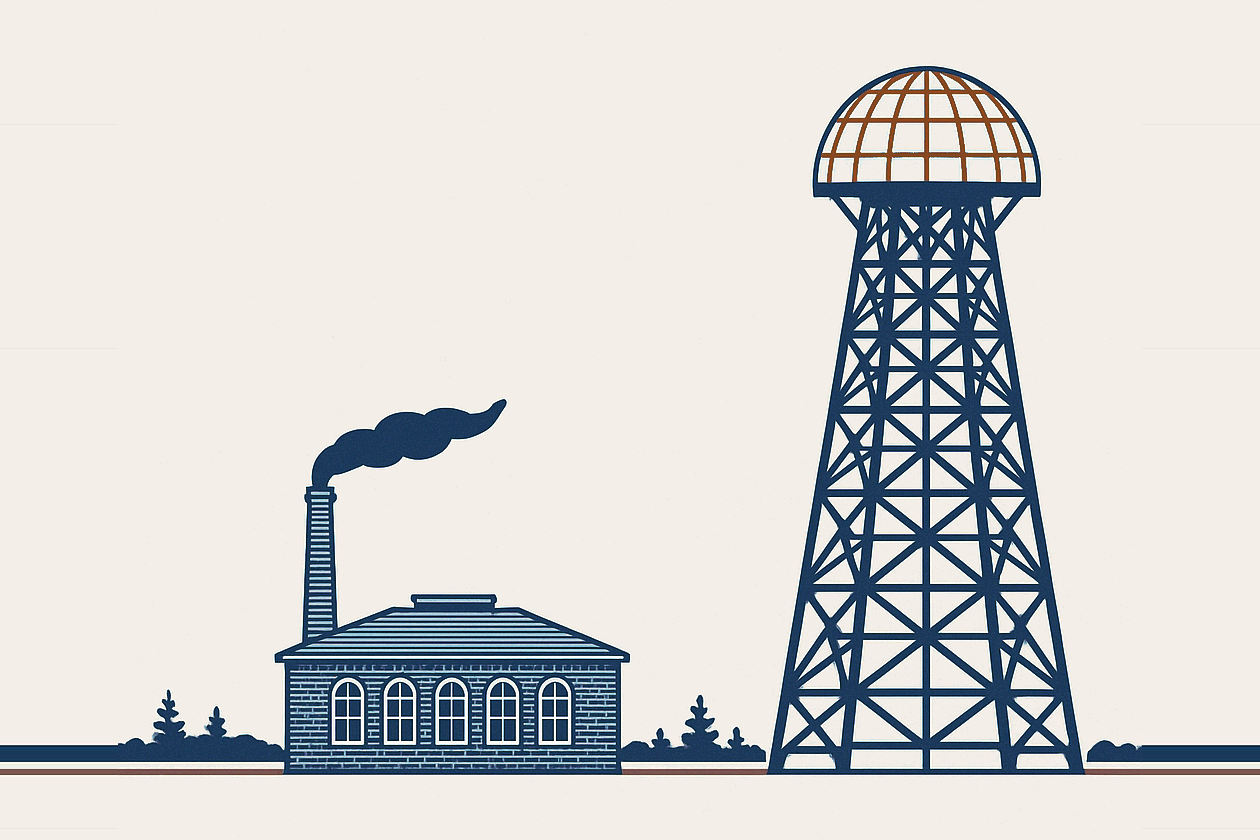
How was Tesla's tower supposed to work? Mechanism first, history afterwards.
A steam plant on the site turned coal into electricity in the ordinary way of 1902. That electricity charged a bank of condensers, which discharged through a primary coil, which rang a large secondary coil at a frequency the patents put below twenty thousand cycles a second. The top of the secondary went up the tower to an enormous metal terminal; the bottom went into the ground, through a shaft sunk a hundred and twenty feet into the sand. The terminal and the earth together behave as a capacitor. Driven at the right rate, the arrangement pumps charge onto that terminal and off it again, and pushes a corresponding current in and out of the earth at the tower's foot.
Tesla's claim — the whole of the invention, and the part that has to be judged — is what happens next. He held that the earth is a conductor of finite size, that a current pushed into it at a low enough frequency travels through it rather than merely leaking away nearby, that it reaches the far side and comes back, and that a transmitter tuned to the round trip will therefore set up a standing wave in the planet itself, with fixed peaks and fixed nodes. Any station anywhere with a ground rod, a matching coil and an elevated terminal could then tap that oscillation, the way a second tuning fork picks up the note of the first. Messages would ride on it. So, he later argued, would power.
That is the mechanism, stated as fairly as it can be. Half of it was pointing at something real; the other half cannot work however well it is engineered. And the fact drawn above is almost never mentioned: there was a coal-fired generating plant on the site. Whatever the tower at Shoreham was, it was not a machine for making energy out of nothing, and its own inventor never said it was.
Two hundred acres at Shoreham.
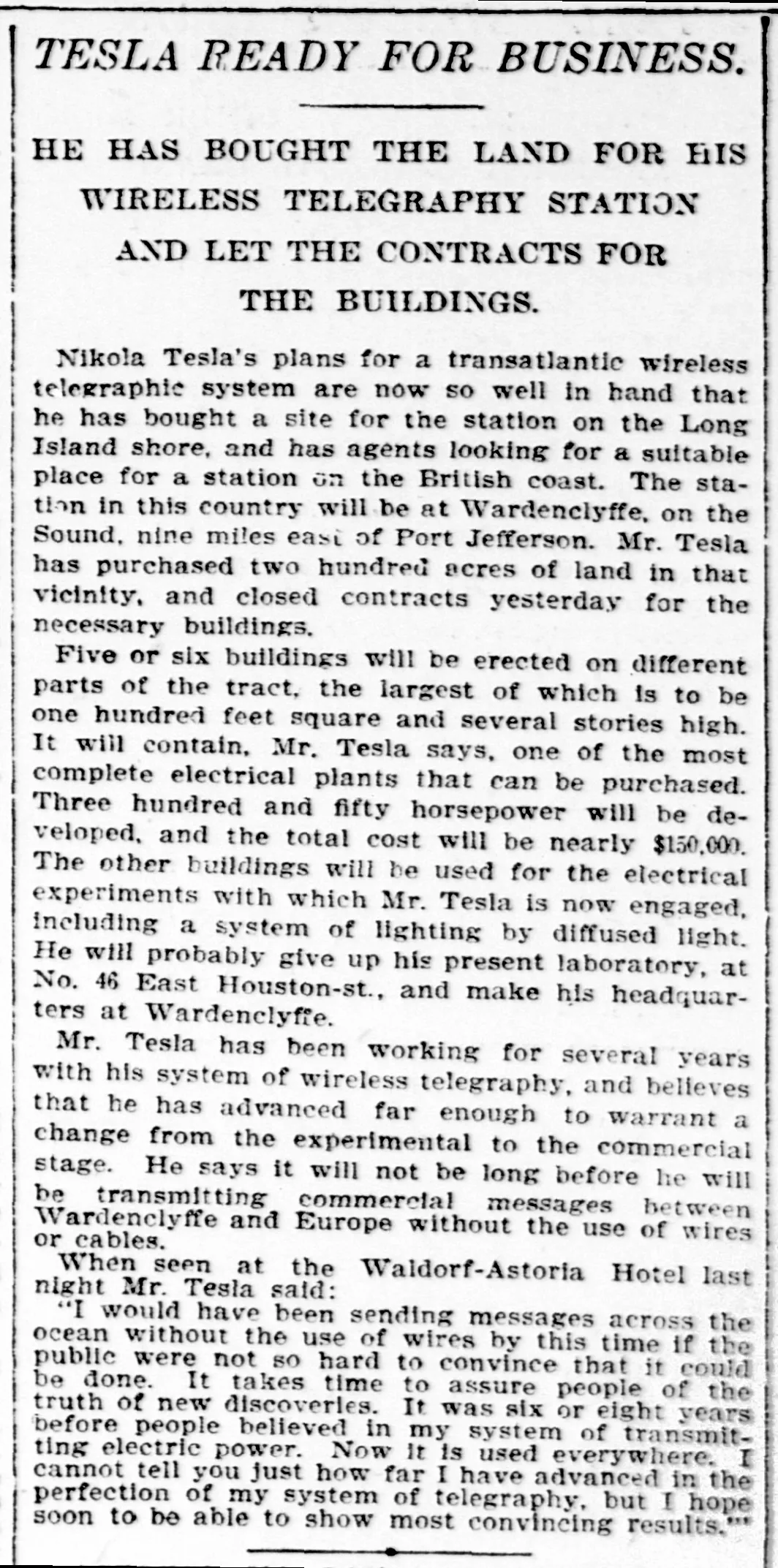
In the summer of 1901 Tesla took land on the north shore of Suffolk County, New York, in the town of Brookhaven, from James S. Warden, a lawyer and a director of the Suffolk County Land Company who had bought a large tract there and wanted a reason for people to move to it.1 Warden's plan was a "Radio City": housing on the rest of his land for the two thousand to two and a half thousand people he expected Tesla's factories to employ. The place was named Wardenclyffe for him. The parcel is usually given as about two hundred acres, and Anderson, writing from the local records, places it beside the Jemima Randall and George Hegeman farms at Shoreham, "65 miles from Brooklyn."2 The local paper reported on 2 August 1901 that Tesla had "closed a contract for the immediate building of a wireless telegraph plant" and that work would start within thirty days.3 Note the words the neighbours were given: a wireless telegraph plant.
The building went up first. It is a square brick box, ninety-four feet on a side, one and a half storeys, nine bays by nine, with a side-gabled roof and a chimney rising through the middle of it; the National Park Service records it in almost those terms.4 The architects were McKim, Mead & White, and the partner who took the job was Stanford White, who had known Tesla for years and worked, by all accounts, largely for the interest of it. The tower itself was drawn by W. D. Crow, an associate in White's office.5 Inside the building were a boiler room, an engine and dynamo room, a machine shop and a laboratory — the plan of a small industrial works, because that is what it was.
The tower reached 187 feet. It was a timber lattice, octagonal, its members cut and assembled on the ground and hoisted into place, tapering from a wide base to a platform at the top. On that platform sat a hemispherical steel framework about sixty-eight feet across, generally put at fifty-five tons, which was eventually to be closed in with copper plates so that the whole thing became one large insulated conducting ball.6 That plating was never done. Photographs of the finished structure show the ribs bare, and the sources that describe the copper describe it as an intention.
Below the tower a shaft went down a hundred and twenty feet: twelve feet square, lined with eight-inch timbers, with a spiral stairway winding round a steel shaft, and iron pipes driven out from the bottom of it into the surrounding ground.7 This is the part visitors are most often surprised by, and it is the part that follows most directly from the patents. If the earth is to be the return conductor, the connection to it cannot be an afterthought; it has to be as good as the terminal in the air. The shaft is the ground terminal, built with the same seriousness as the tower.
What Morgan bought.
In June 1900 The Century Magazine published a long, strange, extremely confident essay by Tesla called "The Problem of Increasing Human Energy," which ranged over solar power, food, war, automata and the transmission of energy without wires.8 It made a sensation, and among the people it reached was J. Pierpont Morgan. In March 1901 Morgan contracted to advance $150,000 in exchange for a controlling interest — the figure normally given is fifty-one per cent — in the wireless patents and in whatever the project produced.9
What did that money buy, in the language of a banker? Transatlantic wireless telegraphy. Not electricity delivered to houses: messages, and the businesses that hang off messages. Tesla's own published prospectus for the system, which he called the World System, is explicit about the product line. Writing in Electrical World and Engineer in January 1905 he lists what a subscriber station would do: "Stock-tickers, synchronous movements and innumerable devices of this character could be worked in unison all over the earth"; "Universal time could be distributed by simple inexpensive clocks requiring no attention and running with nearly mathematical precision"; "Instruments might be provided for indicating the course of a vessel at sea, the distance traversed, the speed, the hour at any particular place, the latitude and longitude."10 Elsewhere in the same period he describes the interconnection of existing telegraph exchanges, private wireless telephony across the ocean, and the reproduction of writing and pictures at a distance — facsimile, in the modern word.
These are all information services. Every one of them is a business Morgan understood, because they were the businesses he already owned or financed: cables, tickers, exchanges. The commercial case put to him was that a single plant on Long Island would undercut the submarine cable companies on price and beat them on reach. That is the case a bank buys.
The power ambition was real, and it was not a later invention by Tesla's admirers — but it was outside the agreement, and it was unfunded. When he set it out in public, in Electrical World and Engineer on 5 March 1904, he did so in the most sweeping possible terms, writing that it was practicable "to transmit power, in unlimited amounts, to any terrestrial distance and almost without loss," and describing a transmitter emitting "a wave complex of total maximum activity of ten million horse-power, one per cent. of which is amply sufficient to 'girdle the globe.'"11 By then Morgan had already refused to advance anything further. The two facts belong together: the largest claims about Wardenclyffe were made after the money for Wardenclyffe had stopped, and were in part an attempt to restart it.
The engine room, and the fact that settles the argument.
The same 1904 article carries a photograph of the Long Island site, under a caption that reads: "Tesla Central Power Plant and Transmitting Tower for World Telegraphy, Wardenclyffe, Long Island, N. Y."12 Two things are in that one line. The tower is for world telegraphy. And the building beside it is a central power plant — a phrase that in 1904 meant exactly one thing: a place where fuel is burned to make electricity.
The equipment bears it out. Westinghouse supplied the electrical plant for the site — boilers, engines and dynamos. Two steam engines of a hundred horsepower each were delivered and being installed by November 1901. The alternator was a Westinghouse machine rated at 200 kilowatts, driven directly by a compound steam engine. Beyond it stood four Westinghouse transformers, steel tanks holding banks of condensers, and the regulating coils that fed the primary.13 None of that is exotic. It is the plant of a small municipal electricity works of the period, and it ran on coal bought by the carload.
This is where the popular story of Wardenclyffe breaks, and it breaks on a detail that is still standing. Tesla's laboratory survives at Shoreham, and it has a chimney. A machine that generates free energy for the world does not need a flue. The tower could not have been switched on at all without somebody first buying coal — and there is a documented stretch in which Tesla, out of money, could not buy it, and the boilers stayed cold.14
None of the four patents the scheme rests on describes a source of energy either. They are titled, in order, a system of transmission, an apparatus for transmission, an art of transmitting, and an apparatus for transmitting. Transmission is a delivery problem. Somebody, somewhere, still has to make the electricity.
The four documents
US 645,576 — System of Transmission of Electrical Energy. Filed 2 September 1897, granted 20 March 1900.
US 649,621 — Apparatus for Transmission of Electrical Energy. Filed 19 February 1900, granted 15 May 1900.
US 787,412 — Art of Transmitting Electrical Energy Through the Natural Mediums. Filed 16 May 1900, granted 18 April 1905.
US 1,119,732 — Apparatus for Transmitting Electrical Energy. Filed 18 January 1902, renewed 4 May 1907, granted 1 December 1914.
Titles and dates transcribed from the patent faces. All four are in the public domain. The full US grant list is at /patents/.
What Colorado Springs was supposed to have proved.
The earth-conduction claim was not arrived at in an office. Tesla believed he had measured it, and the place he believed he had measured it was Colorado Springs, where he worked from May 1899 to January 1900 in a shed built to hold a transmitter too large for any room in New York. The daily record of that work survives — an unusually disciplined one for him, with dated entries, readings and sketches — and was published in facsimile as Colorado Springs Notes, 1899–1900.15
The decisive entry is dated 3 July 1899. A heavy storm passed over the station and moved off to the east, and as it receded Tesla's receiving instruments did not simply fade: by his account they passed through a repeating series of maxima and minima, growing strong again at intervals after having gone quiet. He read that pattern as nodes and antinodes — as evidence that the discharges were setting up a standing wave in the earth itself, with fixed positions of strength and weakness. He regarded it for the rest of his life as the most important thing he ever found, and it is the observation on which the central assertion of US 787,412 rests.16
Later readings of the same notes explain the alternating strength differently: as interference between the wave travelling along the ground and waves returning from the conducting layers of the upper atmosphere, which produces exactly that pattern of fading and recovery in a receiver watching a source that is moving away. That explanation was not available in 1899, for the plain reason that nobody yet knew there was a layer up there to reflect anything. The measurement was real. The inference from it was the error, and it is worked through in detail in the article on the Colorado Springs notes.
The premise, as the patents actually state it.
The four documents do not say the same thing, and the differences between them are the most interesting part of the record. Read in order, they show a man changing his mind about the hardest question in his own scheme: where does the current come back?
The earliest, US 645,576, filed in 1897, answers through the air. Its terminals are to be raised — the patent proposes "a balloon at an elevation suitable for the purposes of transmission" — and the voltage is to be high enough "to render the air strata at or near the elevated terminal conducting," so that current impulses pass through those strata to a distant receiver tuned to them.17 The laboratory model behind that claim is described in the same document: a fifty-foot insulating tube held at a pressure of between about 120 and 150 millimetres of mercury, through which the discharge would pass freely. Rarefied air conducts. Tesla had seen it conduct in a tube on his bench, and reasoned that the thin air of the upper atmosphere would do the same on a planetary scale.
By US 787,412, filed in 1900 and granted in 1905, the emphasis has shifted decisively to the ground. This is the document that states the premise most plainly. It notes that "it is known since a long time that electric currents may be propagated through the earth," and then makes the leap: that "the terrestrial globe may in a large part or as a whole behave toward disturbances impressed upon it in the same manner as a conductor of limited size." From that, stationary waves — "the phenomenon of stationary waves with maxima and minima in definite fixed positions is produced" — and a working frequency, which the patent puts below twenty thousand per second.18 In the 1904 article he put the same idea in one sentence, and it is the best summary he ever gave of his own hypothesis: "this planet, with all its appalling immensity, is to electric currents virtually no more than a small metal ball."19
The last of the four, US 1,119,732, filed in January 1902 while Wardenclyffe was going up, is almost an admission of what was going wrong. Its subject is leakage. Tesla writes that in adapting very high tension currents to practical use he has "encountered difficulties in confining considerable amounts of electricity to the conductors and preventing its leakage over their supports, or its escape into the ambient air," and his answer is geometric: make every surface of the terminal a large radius of curvature, because "the smaller the radius of curvature the greater, for a given electric displacement, will be the surface-density and, consequently, the lower the limiting pressure to which the terminal may be charged without electricity escaping into the air."20 That is the engineering reason for the giant smooth ball on top of the tower. It is not decoration and it is not a mystery: a sphere sixty-eight feet across is about the largest radius of curvature that could be hoisted to that height, and it exists to stop the charge bleeding off into the sky before it can do any work.
Which half of it was right.
Tesla was not a crank, and the honest verdict on Wardenclyffe is not a single word. His central intuition — that very low frequency disturbances hug the earth and travel around it with far less loss than anybody in 1900 expected — was pointing at something that turned out to be true. Very low frequency radio does propagate globally, guided between the surface of the earth and the electrically conducting layers of the upper atmosphere, and navies still use it for exactly that reason, because it is the band that will reach a submerged submarine anywhere in the world. The mechanism is not the one the patents describe: the guide is the gap between the ground and the lowest ionised layer of the atmosphere, whose underside sits at roughly seventy kilometres by day and eighty-five to ninety by night. That layer's existence was not demonstrated until Appleton and Barnett in 1924 and Breit and Tuve in 1925.21 But the phenomenon Tesla was chasing at Colorado Springs and at Shoreham — a signal that goes round the world without a wire — was a real one, and the telegraphic half of his scheme was aimed at a real target.
The power half fails, and it fails on four separate counts, each of which is enough on its own.
The return path is not where the patents put it. US 645,576 asks for conducting air at a height a balloon can reach, on the strength of a discharge tube fifty feet long at a hundred-odd millimetres of pressure. The atmosphere does not become usefully conducting at balloon heights. It becomes conducting tens of kilometres higher, where no terminal Tesla could build would ever go. A 187-foot mast is not a shortened version of a fifty-kilometre one; it is a different problem.
The earth is a conductor, but a poor and lossy one. Ground resistivity is not a constant of nature. It runs from a few ohm-metres in wet clay to thousands in dry sand and hard rock, and it varies by an order of magnitude between one end of a continent and the other. Current pushed into the earth at Shoreham does not run along a wire; it fans out through a resistive medium and heats it. The heating is real work, taken out of the transmitted energy before it arrives anywhere.
The geometry cannot be argued with. This is the objection in Fig. 4, and it is the one that no improvement in materials or engineering can touch. A transmitter designed to establish an oscillation over the entire planet has, by construction, spread its output over the entire planet. A receiving station takes the share of that disturbance which crosses its own small aperture, and no more. Tesla's own arithmetic gives the game away: one per cent of ten million horsepower is enough to "girdle the globe," he wrote — but girdling the globe is not delivering to a customer, it is the opposite of delivering to a customer. A radio receiver survives that division because it can be made arbitrarily sensitive and only needs to distinguish a dot from a dash. A lamp cannot be made more sensitive. It needs the actual watts.
The tower is electrically tiny. At a frequency below twenty thousand cycles a second the wavelength is fifteen kilometres or more. A radiator 187 feet high is fifty-seven metres — about one two-hundred-and-sixtieth of a wavelength, and less than that at every lower frequency the patents allow. The radiation resistance of a short vertical radiator falls off as the square of its height in wavelengths, so at Wardenclyffe's proportions it is a small fraction of an ohm, while the resistance of the coil, the ground system and the corona losses are far larger. Nearly everything put into such a structure sloshes back and forth as stored energy and comes out as heat and glow rather than as radiated power. That is not an incidental defect; it is precisely the problem US 1,119,732 was filed to fight, and the giant dome was the fix, and the fix was not sufficient.
There is a fifth objection that is commercial rather than physical, and it is usually put in Morgan's mouth without evidence. A distribution scheme in which any person with a ground rod and a tuned coil can draw from the common oscillation has no meter in it. That is a genuine and obvious flaw in the business proposition. What the record does not contain is any statement by Morgan that this is why he stopped paying, or indeed any contemporary putting the objection to him at all. His refusal, quoted below, gives no reason of any kind.
One further caution, because it is the commonest way this argument is conducted badly today. Tesla's figures for the earth's resonant period are often matched up against the Schumann resonances of the earth–ionosphere cavity, as though he had discovered them. Those resonances were derived in 1952, and the frequency this patent implies is not the one they sit at. The arithmetic is worked through in the article on what he actually proposed.
December 1901.
While the brickwork at Shoreham was going up, the commercial question was being settled eleven hundred miles to the north-east by somebody else.
On 12 December 1901, on Signal Hill above St John's, Newfoundland, Guglielmo Marconi and his assistant George Kemp raised a wire aerial on a kite — the first kite was carried off by the gale, the second held — and reported hearing the three dots of the Morse letter S, sent at prearranged times from a station at Poldhu in Cornwall. Marconi's notebook records signals at 12:30, 1:10 and 2:20 local time. They reported hearing them again, less distinctly, the next day; on the 14th the wind made it impossible to get an aerial up at all.22
This reception has never been independently verified and has been seriously doubted by specialists ever since. There was no recording, and nobody outside Marconi's own party heard anything; the receiver was untuned and had no amplification, so it could have responded to atmospheric noise; and the whole path was in daylight, which is the worst condition for the wavelength Marconi is thought to have been using. The most careful published examination of the question, by J. S. Belrose in 1995, reconstructs the Poldhu transmitter at about 850 kilohertz and concludes that it is "difficult to believe that signals could have been heard on Signal Hill."23
It made no difference whatever. What decided where the money went was not whether the letter S crossed the Atlantic in December 1901 but whether the newspapers, the investors and the cable companies believed it had. They did. Marconi had achieved, or was credited with achieving, on a kite and a length of wire, the thing for which Shoreham was consuming a fortune in brick, timber, steel and steam plant. The comparison a banker would draw is not subtle, and it did not require any engineering judgement at all.
This is the sense in which Marconi, not Morgan, is the decisive second figure in the Wardenclyffe story. Morgan's role was to stop; Marconi's was to make stopping look sensible. Tesla and Marconi would still be entangled four decades later, when the Supreme Court took apart Marconi's tuning patent and cited Tesla's US 645,576 among the prior art — a case routinely misdescribed as ruling that Tesla invented radio, and examined in its own article here.
The letters.
The correspondence between Tesla and Morgan in the spring and summer of 1903 is the closest thing the record has to a transcript of the project's collapse, and it is worth reading for tone as much as for content.
On 8 April 1903 Tesla wrote about costs, blaming the general boom for the price of everything at Shoreham having risen: "You have raised great waves in the industrial world and some have struck my little boat. Prices have gone up in consequence twice, perhaps three times higher than they were."
Nikola Tesla to J. P. Morgan, 8 April 1903. Quoted from a published transcription of the Wardenclyffe correspondence; the original was not examined for this article.
On 22 April he tried gratitude: "You have extended me a noble help at a time when Edison, Marconi, Pupin, Fleming, and many others openly ridiculed my undertaking and declared its success impossible."
Nikola Tesla to J. P. Morgan, 22 April 1903. Same transcription; original not examined.
Then, on 3 July 1903, the sentence that tells you what had actually been withheld. Having explained at last that the plant was intended to transmit power and not only intelligence, he wrote:
If I would have told you such as this before, you would have fired me out of your office. Will you help me or let my great work — almost complete — go to pots?
Nikola Tesla to J. P. Morgan, 3 July 1903. Same transcription; original not examined.
Morgan answered on 14 July 1903, without argument: "I have received your letter . . . and in reply would say that I should not feel disposed at present to make any further advances."24
Read those two together and the shape of the failure is clear, and it is not the shape the legend gives it. Tesla is not being silenced. He is telling a man who bought a telegraph company that he has been building something else, and asking him to fund the something else. Morgan declines without argument, without explanation, and without recovering his $150,000. The word that does not appear anywhere in the exchange is suppression.
Something did happen at the tower that same month. Neighbours reported flashes and noise from the structure at night in July 1903, and the press picked the reports up. No measurement of any kind survives from those tests — no log, no reading, no independent observer with an instrument. What Tesla learned from them, if anything, is not in the record.25
Default, foreclosure, demolition.
After 1903 the site ran on credit and then on nothing. Tesla mortgaged the property in 1904 and again in 1908 to George C. Boldt, the proprietor of the Waldorf-Astoria, against unpaid hotel bills; in 1912 Westinghouse obtained a judgment against him for machinery supplied. In 1915 legal ownership of Wardenclyffe passed to the Waldorf-Astoria company against a debt of about twenty thousand dollars.26 Tesla and his staff had left in the autumn of 1906; the neighbours noticed the plant had been abandoned without notice.
The tower came down in 1917. The contractor was the Smiley Steel Company of New York, working under William H. Glancey; the tower was set with dynamite on 4 July 1917, the charge did not bring it down, and the work ran on to the next holiday, Labour Day. The scrap realised $1,750 above the cost of demolition. On 20 April 1922 Tesla lost his appeal against the foreclosure.27
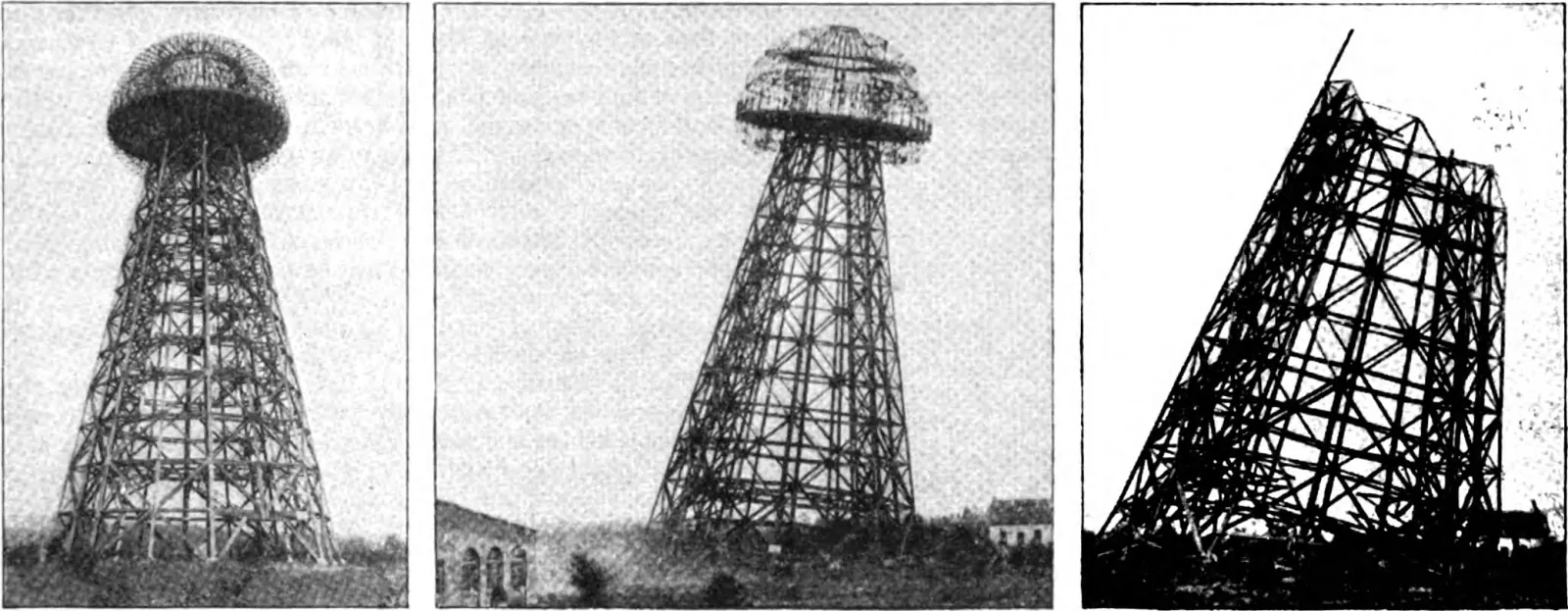

The wartime rumour — that the federal government ordered the tower destroyed because German agents were using it, or because U-boats were navigating by it — was current at the time and has never been supported by a document. No order has been produced, from any department, in a century of looking. What has been produced is the debt, the mortgages, the deed and the appeal record. A creditor sold a large quantity of timber and steel to recover money it was owed, in the middle of a war, when scrap was worth having. That is a duller explanation and it is the one with paper behind it.
The property afterwards went to Walter L. Johnson in 1925 and to Plantacres, Inc. in 1939, which leased it to Peerless Photo Products; for most of the twentieth century Tesla's laboratory was a photographic-materials works, which is the mundane reason it survived at all. Somebody kept the roof on.
What the tower was for, in one paragraph.
It was for sending messages across the Atlantic without a cable, paid for by a bank that wanted the message business, using a method its inventor believed would later carry power as well. The method rested on a claim about the earth that was half right: the world-circling signal is real, the world-circling power supply is not, and the difference between them is arithmetic rather than opinion. The tower was never brought into full operation, no measurement of any transmission from it survives, and the plant that would have driven it burned coal, in a building with a chimney — a chimney that is still standing at Shoreham, scorched by the 2023 fire and under repair, a hundred and nine years after the tower it was built to feed came down.
The site as it stands.
Sixteen acres of the original property survive with the laboratory on them. On 2 May 2013 the site was bought for $1.6 million by the non-profit Tesla Science Center at Wardenclyffe, funded by an online campaign and a matching New York State grant; the building was listed on the National Register of Historic Places on 27 July 2018, reference number 100002744.28 In April 2023 New York State announced support for a redevelopment of the campus budgeted at about $20 million.29
Late in the afternoon of 21 November 2023 a fire tore through the laboratory. Well over a hundred firefighters from seventeen departments answered it; the original roof, the chimney and the cupola were severely damaged, along with steel girders and part of a wall on the north side, though the 1901 brick shell largely held. The centre put the cost at more than $3 million.30 Ground was broken on 5 September 2025 for a 2,200-square-foot visitor building, the Eugene Sayan Visitor Center — the site's first purpose-built visitor facility — and it was dedicated on 11 July 2026, during the centre's annual Nikola Tesla Expo.31 Restoration of the laboratory itself continues. Opening days have changed repeatedly since the fire, and the centre's own site is the place to check them before travelling.
The document
This article is built on US 787,412, Art of Transmitting Electrical Energy Through the Natural Mediums, filed 16 May 1900 and granted 18 April 1905 — the patent in which the earth-conduction premise is stated in Tesla's own words, together with US 645,576 and US 1,119,732. All three are out of copyright, and each number above links to the scanned grant. Their place in the whole US grant list is at /patents/.
The whole thing, printed
How Does Tesla’s Tower Work? — the same subject taken further and set for print: the machine in seven stages, the return path the patents actually specify, the resonance argument with the arithmetic beside it, and the four objections to the power half, worked out. Fourteen pages, with six diagrams drawn for it — the installation in section, the transmitter as a circuit, Tesla’s earth-coupled theory against what happens instead, resonance and the quality factor, and the division that supports telegraphy and refuses power.
PDF, 445 KB, 14 pages. The page is 210 × 279 mm, the overlap of A4 and US Letter, so it prints on either with nothing cut off and no scaling.
Search log
What was looked for, including what returned nothing.
The March 1901 agreement itself. No text or scan of the instrument was located in any public repository. Every account of its terms — the $150,000, the fifty-one per cent, the scope — is secondary. The figures are consistent across the accounts consulted; the document is not in evidence here and is not treated as if it were.
Originals of the 1903 letters. Not located. The passages quoted above follow published transcriptions of the Wardenclyffe correspondence, and the manuscripts were not examined. Each quotation is labelled accordingly rather than presented as read from the original.
The "you cannot meter it" story. The line that Morgan withdrew because wireless power could not be billed for is repeated everywhere and is attached to no document. Nothing was located: no letter, no interview, no contemporary report of anyone putting the objection to Morgan or to Tesla. The metering flaw is real, and it is stated above on its own merits; the attribution to Morgan is not.
The date of Morgan's refusal. Several current web accounts date it 3 July 1903. That appears to conflate Tesla's letter of 3 July with Morgan's reply; the 1968 Long Island Forum account, which worked from the correspondence, gives 14 July, and that date is used here.
A government order to demolish the tower. Nothing located, from any department, in any archive index searched. The documented instruments are the mortgages, the 1915 transfer and the 1922 appeal.
Evidence the dome was ever plated. Nothing located. The copper enclosure is described in the sources as an intention; photographs show the ribs bare.
Measurements from the 1903 tests. Nothing located: no log, no instrument reading, no third-party observation. Newspaper reports of flashes are the whole of the record.
The acreage. Two hundred acres is the figure in the modern accounts and in the compilations of the 1901 local reporting. Anderson, closest to the local records, describes the parcel and its neighbouring farms without printing an acreage, so it is given here as approximate rather than as a surveyed number. Revised 5 October 2026: a contemporary printing has since been located. The New-York Tribune of 7 August 1901, page 4, carries “Mr. Tesla has purchased two hundred acres of land in that vicinity”, five days after the local report, and the page is in Fig. 3. That moves the figure from modern compilation to contemporary newspaper. It is still a reporter's number and not a surveyed one — a deed would settle it, and no deed was located — but it is now datable to the month of the purchase.
The generating plant rating. The equipment list gives a direct-connected Westinghouse alternator of 200 kilowatts, and that is the figure printed above. The same compilation adds that a 300-kilowatt machine was brought in later; when, and whether it ever ran, is not settled by anything located here.
Notes
- On Warden, the Suffolk County Land Company and the naming of the site: Leland I. Anderson, "Wardenclyffe — A Forfeited Dream," Long Island Forum, August 1968, pp. 146–149, and September 1968, pp. 169–172. ↩
- Anderson, Long Island Forum, August 1968: "a remote wooded parcel adjacent to the Jemima Randall and George Hegeman farms at Shoreham, L. I., 65 miles from Brooklyn." The two-hundred-acre figure, and Warden's expectation of 2,000 to 2,500 employees housed on his remaining land, are standard in the modern accounts and in the compilations of the 1901 local reporting; Anderson gives no acreage. See the search log above. ↩
- Port Jefferson Echo, 2 August 1901, reporting the contract and a thirty-day start; quoted in the compiled Wardenclyffe chronology at Open Tesla Research. ↩
- Wardenclyffe Laboratory, National Park Service: "One and one half story, nine bay by nine bay brick building with a side-gabled roof," designed to Tesla's specifications by McKim, Mead and White. The ninety-four-foot square is the figure carried by the site's own historical material. ↩
- Anderson, Long Island Forum, August 1968: White designed the principal building, and W. D. Crow, an associate in his office, designed the transmission tower. ↩
- Anderson, Long Island Forum, September 1968: a "55-ton, 68-foot spherical rib-cage," which "was eventually intended to enclose … with copper plates so that an insulated metal ball would be formed." ↩
- Anderson, Long Island Forum, 1968: "Below the tower a well had been dug 120 feet deep and twelve feet square, lined with eight inch timbers. A spiral stairway encircled a vertical steel shaft rising to the surface." Some accounts give the excavation as ten by twelve feet rather than twelve square. ↩
- Nikola Tesla, "The Problem of Increasing Human Energy, with Special Reference to the Harnessing of the Sun's Energy," The Century Magazine, vol. LX, no. 2, June 1900, pp. 175–211. ↩
- The $150,000 and the controlling interest in the wireless patents are given consistently across modern accounts of the March 1901 contract. The instrument itself was not located; see the search log. ↩
- Nikola Tesla, "The Transmission of Electrical Energy Without Wires As a Means for Furthering Peace," Electrical World and Engineer, 7 January 1905, pp. 21–24. ↩
- Nikola Tesla, "The Transmission of Electrical Energy Without Wires," Electrical World and Engineer, 5 March 1904, pp. 429–431. ↩
- Figure caption, Electrical World and Engineer, 5 March 1904: "Tesla Central Power Plant and Transmitting Tower for World Telegraphy, Wardenclyffe, Long Island, N. Y." ↩
- Westinghouse supplied the boilers, engines and dynamos; two 100-horsepower steam engines were arriving in November 1901, and the alternator is given as a 200-kilowatt Westinghouse machine, direct-connected to a compound engine. Compiled from period records at Open Tesla Research, "Generating room". ↩
- Anderson, Long Island Forum, 1968, recording that Tesla at one point lacked the money for a carload of coal to fire the laboratory boilers. ↩
- Nikola Tesla, Colorado Springs Notes, 1899–1900, Nolit, Belgrade, 1978 — a facsimile edition of the dated daily record kept at the station between June 1899 and January 1900. ↩
- The entry of 3 July 1899, and Tesla’s reading of the receding storm as evidence of stationary waves in the earth, are in the same notes; he restated the claim in US 787,412 and in Electrical World and Engineer, 5 March 1904. ↩
- US 645,576, System of Transmission of Electrical Energy, specification and claims 5 and 6: a terminal "formed or maintained by such means as a balloon at an elevation suitable for the purposes of transmission," and impulses "of a sufficiently high electromotive force to render the air strata at or near the elevated terminal conducting." The fifty-foot tube at 120–150 millimetres is described in the same specification. ↩
- US 787,412, Art of Transmitting Electrical Energy Through the Natural Mediums, specification: "the terrestrial globe may in a large part or as a whole behave toward disturbances impressed upon it in the same manner as a conductor of limited size"; "the phenomenon of stationary waves with maxima and minima in definite fixed positions is produced"; and "the frequency should be smaller than twenty thousand per second." ↩
- Electrical World and Engineer, 5 March 1904, as above. ↩
- US 1,119,732, Apparatus for Transmitting Electrical Energy, opening specification and the passage on radius of curvature and surface density. ↩
- E. V. Appleton and M. A. F. Barnett demonstrated a reflecting layer by frequency-change interference in 1924; G. Breit and M. A. Tuve did so by pulse sounding in 1925. Both post-date every one of the four patents. ↩
- The reception of 12 December 1901 at Signal Hill, the kite-borne aerial, the letter S from Poldhu, the notebook times of 12:30, 1:10 and 2:20, the fainter repetition on 13 December and the gale that stopped the work on the 14th are set out at Engineering and Technology History Wiki, "Milestones: Reception of Transatlantic Radio Signals, 1901". ↩
- J. S. Belrose, "Fessenden and Marconi: Their Differing Technologies and Transatlantic Experiments During the First Decade of This Century," IEE International Conference on 100 Years of Radio, conference publication 411, 5–7 September 1995, pp. 32–43: the Poldhu transmitter is reconstructed at about 850 kHz, the St John's receiver was "an untuned receiver which had no means of amplification whatsoever," the whole path was in daylight, and "it is therefore difficult to believe that signals could have been heard on Signal Hill." ↩
- J. P. Morgan to Nikola Tesla, 14 July 1903. Quoted from a published transcription; the original was not examined. ↩
- Reports of flashes and noise at the tower in July 1903 appear in the contemporary press and in the compiled chronologies. No measurement from the tests has been located. ↩
- The 1904 and 1908 mortgages to George C. Boldt, the 1912 Westinghouse judgment for machinery supplied (given as $23,500), and the 1915 transfer of the property against a debt of about $20,000 are given in the standard accounts of the site's disposal; Anderson has Tesla turning the deed over to Waldorf-Astoria, Inc. "through a silent intermediary," and dates the departure of Tesla and his staff to the autumn of 1906. No instrument in this sequence was examined in the original for this article. ↩
- Anderson, Long Island Forum, September 1968: the salvage contract went to the Smiley Steel Company of New York, the work was supervised by Wm. H. Glancey of Shoreham, the tower "was set with dynamite on July 4, 1917," the job "took until the next holiday — Labor Day," and "only $1750 was realized above demolition costs." Anderson does not carry the 1922 appeal; the date of 20 April 1922, on Boldt's original foreclosure judgment, is from the standard modern accounts of the site's disposal. ↩
- Wardenclyffe Laboratory, National Register of Historic Places reference number 100002744, listed 27 July 2018; purchase of the site on 2 May 2013 for $1.6 million. ↩
- Office of the Governor of New York, announcement of April 2023, on the $20 million redevelopment of the Tesla Science Center campus. ↩
- The fire of 21 November 2023, the response of well over a hundred firefighters from seventeen departments, the severe damage to the roof, chimney and cupola, and the figure of more than $3 million are reported by the Tesla Science Center itself and in the Long Island press. The cause was never officially determined. ↩
- Groundbreaking on 5 September 2025 for the 2,200-square-foot Eugene Sayan Visitor Center, and its dedication on 11 July 2026 during the centre's annual expo, as reported in the Riverhead News-Review and the local press. Status verified 8 August 2026. ↩
Primary documents
- US 645,576, System of Transmission of Electrical Energy, filed 2 September 1897, granted 20 March 1900.
- US 649,621, Apparatus for Transmission of Electrical Energy, filed 19 February 1900, granted 15 May 1900.
- US 787,412, Art of Transmitting Electrical Energy Through the Natural Mediums, filed 16 May 1900, granted 18 April 1905.
- US 1,119,732, Apparatus for Transmitting Electrical Energy, filed 18 January 1902, renewed 4 May 1907, granted 1 December 1914.
- Nikola Tesla, "The Problem of Increasing Human Energy," The Century Magazine, vol. LX, no. 2, June 1900, pp. 175–211.
- Nikola Tesla, "The Transmission of Electrical Energy Without Wires," Electrical World and Engineer, 5 March 1904, pp. 429–431.
- Nikola Tesla, "The Transmission of Electrical Energy Without Wires As a Means for Furthering Peace," Electrical World and Engineer, 7 January 1905, pp. 21–24.
- Tesla–Morgan correspondence, 8 April, 22 April, 3 July and 14 July 1903, as transcribed in published compilations; originals not examined.
- "Tesla Ready for Business," New-York Tribune, 7 August 1901, page 4. Digitised page, Library of Congress.
- Photographs of the tower standing and dismantled, The Literary Digest, volume 55, 8 September 1917, page 25, credited there to the American Press Association. The article title on that page was not verified here.
- Wardenclyffe Laboratory, National Register of Historic Places, reference number 100002744, listed 27 July 2018.
Further reading
- Leland I. Anderson, "Wardenclyffe — A Forfeited Dream," Long Island Forum, August 1968, pp. 146–149, and September 1968, pp. 169–172. The closest thing to a local documentary history of the site.
- J. S. Belrose, "Fessenden and Marconi: Their Differing Technologies and Transatlantic Experiments During the First Decade of This Century," IEE International Conference on 100 Years of Radio, conference publication 411, September 1995, pp. 32–43.
- "Milestones: Reception of Transatlantic Radio Signals, 1901", Engineering and Technology History Wiki.
- W. Bernard Carlson, Tesla: Inventor of the Electrical Age, Princeton University Press, 2013 — chapters 12 and 13 for the Morgan negotiation and the Wardenclyffe years.
- "Wardenclyffe Laboratory", National Park Service.
- Tesla Science Center at Wardenclyffe, for the condition of the site and current opening days.
The record on this article
- False "Wardenclyffe was going to give the world free energy." All four patents behind it are transmission patents; none describes a source. The site's own power came from a Westinghouse steam plant, and Tesla's 1904 caption for the photograph calls the building a "Central Power Plant". The chimney is still standing.
- False "The government destroyed the tower to suppress it." No order has been produced, from any department, in a century of looking. What has been produced is the paperwork: mortgages in 1904 and 1908, a Westinghouse judgment in 1912, the deed transferred in 1915 against a hotel debt, and a scrap contract executed from 4 July 1917 that returned $1,750 above costs.
- Half right "He was right that a signal can circle the earth without a wire." It can, and navies use the band daily — but it is guided between the ground and an ionised layer whose existence was not demonstrated until 1924, not conducted through the planet as US 787,412 assumes. The telegraphic half of the scheme was aimed at something real; the power half fails on the return path, on ground loss, on geometry and on the size of the tower in wavelengths.
- Unattributed "Morgan withdrew because wireless power could not be metered." The metering flaw is real and is stated above on its own merits. Nothing ties it to Morgan: his refusal of 14 July 1903 gives no reason of any kind, and no letter, interview or contemporary report putting the objection to him has been located.